
Saturday, October 24, 2026

Last Updated: Wednesday, 12 August 2015 04:31 31 July 2009 Nick Spark Hits: 5086
What: Special Presentation at the Huntington Library
When: The evening of August 12th, at 7 p.m. in the Friend's Hall
Where:The Huntington Library 1151 Oxford Road San Marino, CA 91108
More details: Read below!
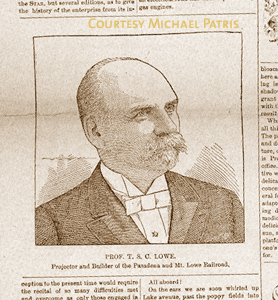
Although it was not incorporated until the 1910s, the area we now know as San Marino was an exclusive and affluent city even in the late 19th Century. By the time that Florence Lowe Dobbins – later in life “Pancho” Barnes – was born, San Marino was home to many powerful and wealthy people. Her parents were representative of that class. Her father Thaddeus Lowe Jr. was the son of Thaddeus Lowe (shown in newspaper at right), whose inventions revolutionized the natural gas industry, and who later built the Mt. Lowe Railway and helped found CalTech. Her mother Florence Mae Dobbins’ father Richard was a Philadelphia blue blood, and an architect of some note. No wonder the Lowe-Dobbins union was widely celebrated in the society pages. One of their wedding presents, courtesy of Florence’s mother, was a modest house in San Marino. It would later be replaced by something more in keeping with the family’s status: a thirty-five-room mansion on South Garfield Avenue complete with servants’ quarters.
Some of the families the Lowes and Dobbins rubbed elbows with back in the day included George S. Patton, Sr., whose grandfather was governor of Virginia and whose son became famous as Major General George S. Patton, Jr. Another would have been the Huntingtons, who controlled a rather large part of Los Angeles’ Pacific Electric trolley system. They may have been neighbors, but they were also rivals in business. Henry Huntington apparently played a role in undermining the Mt. Lowe Railway’s business, and after Thaddeus Lowe went bankrupt in 1902, his company took it over. The loss of the railway, and of Thaddeus Lowe’s personal fortune, signaled the beginning of a long decline in the family’s social standing.
 (Photo at left: A postcard of the great incline portion of the Mt. Lowe Railway, one of the most popular attractions in early 1900's Los Angeles.)
During the Great Depression, Pancho sold her family mansion for $5500, and used the proceeds to help improve a ranch she’d bought in the Mojave Desert -- land that would later become the Happy Bottom Riding Club. The decrepit mansion was later demolished. Just a few years later in 1938, the Mt. Lowe Railway was abandoned and slowly disappeared. Even Henry Huntington’s Pacific Electric trolley system was dissolved, a victim of conspiracy in the late 1940’s.
Fortunately for us, Henry Huntington’s substantial mansion and gardens remain in San Marino, visited by tourists and scholars the world over. (In fact I visited it about eighteen months ago, in order to look at materials related to the Lowe family.) It is a living monument not only to the Huntington family, but to a by-gone era, one that includes the Lowes, Pattons, and Dobbins.
Which is a rather long way of getting around to the fact, that we’ve been invited to San Marino to do a presentation about the documentary. On August 12th, at 7 p.m., join Amanda Pope and I at the Friend’s Hall at the Huntington Library. We’ll be showing a portion of the film, and giving a presentation about the project and one of San Marino’s favorite daughters, Florence “Pancho” Barnes. Dr. Lou D'Elia of the Pancho Barnes Trust Estate will also be in attendance as our special guest. For directions click here.
Last Updated: Wednesday, 12 August 2015 04:31 31 July 2009 Nick Spark Hits: 6907
When Hollywood producers decided to make a movie version of The Right Stuff in 1983, or a TV movie entitled Pancho Barnes in 1988, they wanted an expert to consult with them about their depiction of Pancho. There was only one man to call. He was the same man who had worked with Pancho back in the 1940s, and who had married her back in 1952. Even though he divorced her in 1968, he found himself so strongly connected to her legacy that he could not really escape it. As a result, Mac McKendry – Pancho’s fourth and final husband -- ended up spending the final decades of his life trying to preserve and celebrate her memory. Which was ironic because while she once loved him, by the time she died Pancho pretty much hated his guts.
 People we’ve spoken to who met Mac McKendry socially during the waning years of his life (he died in 2001) describe a charming, down-to-earth fellow who was still handsome after years in the harsh Mojave sun. When Pancho first met him in 1946, he was a dashing farm boy turned ex-military pilot who was down on his luck . According to Lauren Kessler’s book The Happy Bottom Riding Club, Pancho quickly turned things around for Mac, getting him a cushy job as a private pilot for magician John Calvert (photo at right).
Mac once told an interviewer that he and Pancho hooked up the day they first met, and kept up a romantic routine so rigorous that he recalled that it nearly wore him out. Their romance flourished despite the fact that he was 26 -- and she was 45.
When the Calvert job ended, it was natural for Mac to begin working at Pancho’s ranch and airport. Eventually he became the ranch manager, and by most accounts did a fairly good job. But the dashing young man was more than just a good boss to Pancho’s girls. “We all had a crush on him,” remembers Pancho’s head hostess Dallas Morley. “But she said, ‘Hands off, that one’s mine!’ He was a good-looking hunk -- big red beard. Good looking.”
By the time Pancho and Mac decided to get married in 1952, Pancho was 51 and at the apogee of her success. Her Happy Bottom Riding Club guest ranch was a terrific attraction, complete with a hotel, riding stables, pool, airport, restaurant, bar and dance floor, and Pancho was living large -- probably too large to be sustainable. Their wedding was an exercise in largesse, with a a guest list supposedly approaching 1000 people. It featured so many celebrities and military brass that it was covered in all the L.A. papers.
 But just a few years later the lovebirds’ situation would be irrevocably changed. A government lawsuit, an FBI investigation, and two court cases later, Pancho lost her ranch and a great deal of her personal fortune. According to Lauren Kessler, after the summer of 1954 “things were never the same between Pancho and Mac.” They struggled to get their bearings. They frittered away their money, and could not get their mojo back. For Mac, who had thought perhaps that he was marrying into wealth and the excitement, prestige and energy that came with the Happy Bottom Riding Club, the prospect of having to pull himself up by his bootstraps was more than he could stand. Within a short time he began disappearing for long stretches of time. Pancho came to believe he was cheating on her with a waitress named Lenora. She would eventually come to call her rival by a different name: “Lenore the Whore”.
By 1962, ten years after they were first married, Pancho abruptly filed for divorce. She had probably just barely beaten Mac to the punch. It was the beginning of a terrible legal row that would leave them both financially and emotionally exhausted. Pancho got the worst of it; her health had never been very good and the depression she faced over the loss of her livelihood, beloved ranch, and husband must have been overpowering.
So was her anger. In 1966 a young woman named Patrice Demory lived with Pancho, and she vividly remembers the row between Pancho and Mac. “They had quite a bit of verbal warfare,” Patrice told us. “Pancho was constantly trying to find proof [of adultery] against Mac. They were always like, who can get the other’s goat more? There was a war between them. But she was really hurting at the time.”
After a trip to Reno to finalize the divorce, Patrice remembers Pancho “madder than ten chicken hens, like ten cobras . . . I mean you could imagine the worst torture that one could imagine, that one could put on any human being, Pancho would verbalize it.” After it was all over, there was little relief for Pancho. She didn’t even get alimony because Mac was too broke to pay support and apparently too lazy to find a job. Pancho's friend Chuck Yeager summed it up this way: “McKendry was a pretty shrewd guy. He saw Pancho as a good investment. And he used her.”
 Yet while Mac apparently forgot all his feelings for Pancho, he never forgot that she was famous, or that for a time he had been part of the world she had created, in which everything seemed to revolve around her and her ranch. Somehow, it all fell right into his lap. First, when Pancho died in 1975, the only will that could be located was one from prior to Pancho and Mac’s divorce. That document left everything to McKendry and nothing to Pancho’s son Bill. Although Bill contested the will, McKendry ended up with most of Pancho’s personal property and memorabilia.
Then in 1980, Bill Barnes was killed when his P-51 Mustang caught on fire in flight and crashed. Just one year prior to that incident, Tom Wolfe’s book The Right Stuff electrified the nation. Pancho was of course one of the most memorable characters in its pages, and the book’s popularity and Billy’s death had unexpected consequences for Mac. Suddenly, he became the default expert on Pancho, and one of the people most identified with her -- just at the moment she was being re-discovered. McKendry was only too happy to step into the spotlight as “Pancho’s fourth and final husband” and speak about her. He did just that at the first “Pancho Barnes Day” at Edwards AFB in 1980, and continued to do it pretty much right up until he died.
Photo (above): Pancho Barnes and Mac are seen together in Mexico, probably around the time of their wedding. (Photo below): In a dramatic image snapped by an unknown photographer, an elderly McKendry stands in the ruins of the Happy Bottom Riding Club.
 More than anyone else, Mac worked to preserve Pancho’s legacy. For thirty years he labored, trying to save every scrap of paper and every photograph that he’d gotten from his ex-wife’s estate. He bought a surplus railway car, stacked her memorabilia inside it, and talked about opening a museum. He also pursued every scrap of material he could find that might have anything to do with Pancho. According to various sources, if Mac found out that someone had been given a photo or document by Pancho – she was in the habit of making gifts of her papers to visitors – he would cajole and threaten them into surrendering the goods. When that didn’t work, he involved the courts. His lawsuit against Bill Barnes’ widow and other individuals over material he believed was rightfully his, outraged and horrified many of Pancho’s surviving friends. He even went so far as to threaten one of her biographers with legal action, lest she distort Pancho's story. It was obviously an extreme reaction, but Mac believed he was doing what he needed to do in order to preserve his ex-wife’s legacy. Despite the misery they had caused each other at one point in their lives together, in death he had become her guardian and keeper.
Mac didn’t glorify Pancho in interviews, but simply explained the woman he remembered – a tough, sometimes cantankerous woman who had turned his life upside down. It is easy to see that he’d spent some of his most exciting, most memorable days with Pancho. But while Mac could never acknowledge publicly the hurt and pain he’d caused her, or reveal that they’d never reconciled during her lifetime, neither could he move out from under her shadow. In the end, he became better known as “Pancho’s fourth husband Mac” than for any other thing he’d accomplished in his own life.
Last Updated: Wednesday, 12 August 2015 04:31 27 July 2009 Nick Spark Hits: 4984
On August 12th, at 7 p.m., a special presenation will be conducted at the Friend's Hall at the Huntington Library. Join director Amanda Pope and writer/producer Nick Spark as they show a portion of the film, and give a presentation about the project and one of San Marino’s favorite daughters, Florence “Pancho” Barnes. Dr. Lou D'Elia of the Pancho Barnes Trust Estate Archive will also be in attendance as a special guest.
The Huntington Library, Art Collections, and Botanical Gardens is located at 1151 Oxford Road, San Marino, CA 91108
For more information visit their website by clicking here.

Last Updated: Wednesday, 12 August 2015 04:31 22 July 2009 Nick Spark Hits: 4624
The Legend of Pancho Barnes and the Happy Bottom Riding Club will make its Los Angeles premiere at the Aero Theater in Santa Monica on Thursday, September 10th. This special screening will serve as a fund raiser for the production and will feature participants, crew members and many special guests. The public is invited to attend. Tickets may be purchased from this website by clicking on the "Premiere" button at the top right. 
This screening represents the culmination of over four years of hard work by the production team, consisting of writer / producer Nick T. Spark and director Amanda Pope. The film was produced in affiliation with local PBS station KOCE-TV, and was made possible entirely through donations and grants.
Born in Pasadena, Florence Lowe "Pancho" Barnes (1901-1975) was the first woman stunt pilot in Hollywood, a rival of Amelia Earhart's, and a friend of the famous and the fast. August will represent the 80th anniversary of her participation in the 1929 Powder Puff Derby all-women's air race between Santa Monica and Cleveland, Ohio.
The Aero Theater is one of two movie theaters run by the American Cinematheque, a non-profit organization helping to preserve and celebrate motion picture history.
Last Updated: Wednesday, 12 August 2015 04:31 22 July 2009 Nick Spark Hits: 4894
After four years of exhausting, unpaid, hard work -- including research, production, post-production, constant fund raising, and not just a few unexpected headaches -- it gives me great pleasure to announce that we're finally ready to premiere The Legend of Pancho Barnes and the Happy Bottom Riding Club here in Los Angeles.
This is going to be one special, special evening. So many of the people who supported the film, and made it possible, will be in attendance. I hope you'll make it, too.
The date is Thursday, September 10th, and the location is ... well, keep reading below!
There's a story about this premiere. Months ago, when it became clear we were getting close to wrapping up, we talked about where the best and most appropriate place in Los Angeles would be for our a big screening. The Van Nuys Airport (where Pancho broke Amelia Earhart's air speed record) or the Santa Monica Airport (take-off point for the1929 Powder Puff Derby race) were early contenders. But experience gained from taking the film on the road showed that screening in a big, uninsulated hangar can be tricky -- especially if there are noisy flight operations on-going.
Our next thought was to show the film at an historic theater, such as the palatial Egyptian in Hollywood. After all, Hell's Angels debuted at the nearby Chinese, and Pancho herself might have attended a show or two there. But when I emailed the American Cinemateque, who runs the Egyptian, the staffer there sent me back a n email with a smiley face. "The place you want for your screening," she emailed, "is our sister theater ... the Aero in Santa Monica."
Turns out she was absolutely right. The Aero Theater couldn't be a better choice for "Pancho". Built in 1939 by Donald Douglas, yes that Donald Douglas, it takes its name from the fact that it served workers from the Douglas Co.'s aircraft factory! During WWII in fact, the theater was open 24-hours a day so that workers could see the latest newsreels and relax. The fact that the theater is located in Santa Monica makes it all that much more sweet. The night of our screening will be just a couple weeks removed from the 80th anniversary of the finish of the Powder Puff Derby...
Please consider joining us at what should be a truly awesome evening -- celebrating the film and Pancho Barnes and her remarkable friends. And yes, tell all your friends please!
To order advance tickets to the premiere, go to the "Premiere" link on the far right of the navigation bar. But don't dilly-dally -- tickets are going fast and it's likely to be a sell out!
Proceeds from this special screening will benefit the production. Yes, the film is finished but we are still in debt. Hopefully with your help we will get "Pancho" back in the black in the near future.
SILENT AUCTION !
As part of the show, we're planning a silent auction of memorabilia and merchandise. Have something to donate? Contact us using the button on this website.
SPONSORS AND VOLUNTEERS SOUGHT
We're looking for organizations that might be interested in sponsoring our Premiere. It's a great opportunity, as we expect a lot of wonderful people from the aviation and film worlds to be in attendance. Are you available to help the event run smoothly? We'd like a few volunteers to help run our will call booth and our silent auction.
Last Updated: Wednesday, 12 August 2015 04:31 21 July 2009 Nick Spark Hits: 13977

 Product Description
The Legend of Pancho Barnes and the Happy Bottom Riding Club is a documentary profile of one of the most colorful and accomplished female pilots of the early 20th Century. Florence ''Pancho'' Barnes became the first female stunt pilot in Hollywood in 1929 and shattered Amelia Earhart's air speed record in 1930. In the 1940's and 50's, Pancho entertained the best test pilots in the world men with the right stuff at her ''Happy Bottom Riding Club'' guest ranch near Edwards Air Force Base. When Chuck Yeager broke the sound barrier in the rocket-powered Bell X-1 in 1947, he and his team partied with Pancho. A friend of the fast and the famous, Pancho Barnes was a swaggering, forceful woman whose exploits and accomplishments are truly the stuff of legend.
Featuring never-before-seen photographs and film footage and interviews with many of Pancho's friends including astronaut Buzz Aldrin and famed test pilots Bob Cardenas, Bob Hoover and Chuck Yeager The Legend of Pancho Barnes is an unforgettable, exciting, and poignant romp through aviation history. Narrated by Tom Skerritt, with Kathy Bates as the voice of Pancho Barnes.
This deluxe DVD features both the broadcast (57 minute) and extended version (64 minute) of the documentary, along with nearly 18 minutes of additional video including deleted scenes. It also features an audio commentary from writer/producer Nick Spark and director Amanda Pope, a study guide for secondary school students prepared by the staff of the International Women's Air and Space Museum, and more. Please note, the extended version of the documentary contains some material that may be deemed inappropriate for younger viewers. Parental discretion is advised.
Color and B&W. Presented in 16:9 widescreen and in surround sound.
Sample DVD Menus:


DVD box art, DVD menus, design and contents ©2009 Nick Spark Productions, Inc. All rights reserved.
Your tax-deductible donation can help make "The Legend of Pancho Barnes!" a reality.


 O-Sense