Saturday, October 24, 2026

Information Sign up

Sign up to be on our mailing list for updates.

News

Women in Aviation
"Read Nick Spark's article about Pancho
from Women in Aviation magazine (.pdf)"

U.S. Balloon Corps Takes Flight This Weekend

Print Email

U.S. Balloon Corps Takes Flight This Weekend

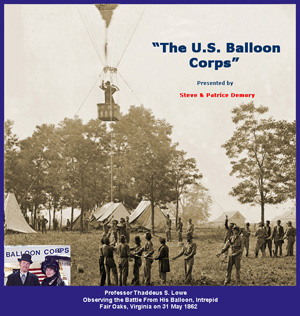
This weekend, November 8th and 9th, there will be a huge Civil War re-enactment at Moorpark, California (for details, visit www.forttejon.org/moorpark). Attending the event will be Patrice and Steve Demory. As a pregnant teen in the mid-1960's, Patrice took refuge at Pancho's home in Cantil. For more on that story, read the wonderful article written about Patrice in the O.C. Register click here

Patrice and Steve won't just be attending the Civil War event, though! They'll be participating in it. You see, although they were friends for only a short time, Pancho made an enormous impression upon Patrice. Demory sought out all the books and magazine articles about Pancho that she could.
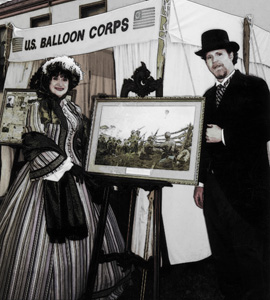
Patrice's research gave her newfound respect for the bawdy, tough old woman she'd known in the 1960's. She developed a special fascination for Pancho's grandfather, Thaddeus Lowe, and his wife Leontine. Patrice's passion proved contagious, and soon her husband Steve was inspired to get into the act. The practical result of all this enthusiasm is something to behold -- since Patrice and Steve re-enact Leontine and Thaddeus at Civil War events around California and the USA!

Come to Fort Tejon this weekend and you can meet them -- and their alter egos. It's like getting four people for the price of two. Imagine the excitement of being able to ask "the most shot at man in the Civil War" about his adventures, and in the next breath you can ask Steve about his trip to see Pancho's old house near Jawbone Canyon. Then, you can ask Leontine to tell you the fascinating story of how she managed to travel around the world as a single woman in her youth, or about her world-famous collection of Native American crafts (now owned by Stanford University). Then, switch gears and ask Patrice to tell the story, about Pancho and the motorcyclist. It's priceless and one you won't want to miss!

Pancho Barnes Returns to Laguna !

Print Email

After a brief hiatus, owing to the arrival of my son Jake (8lbs, 4.6 ounces and both baby and mother are doing nicely, thanks), Amanda Pope and I are back have committed to a series of new events in support of the film. The first of these will take place on Monday night, November 17th. We hope you'll join us at 7:30 pm down at Laguna City Hall for a special evening hosted by the Laguna Beach Historical Society. There is no charge for admission, and there's no need to RSVP. You can read the details on the website: click here
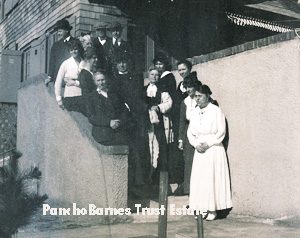
Doing an event in Laguna represents a bit of a homecoming for Pancho -- or Florence Lowe, as she was known in her youth. After all, members of her mother Florence Dobbin's family, were important cogs in Laguna's social machine in the 20's. As a young girl, Florence Lowe most likely went to Laguna each summer. What better way, in a world where air conditioning was in its infancy, than to escape the summer heat of Pasadena by going to the shore?

Photo at left: Pancho's extended family including her mother Florence Mae Dobbins (right) pose at the family home in Laguna, circa 1915. Her father Thad Lowe is the man at the top of the stairs, on the left.

In her late teens, Florence Lowe studied painting in Laguna, and became friends with many of the artists in the community. One of them, George Hurrell, became one of her best friends. There were other, wonderful distractions as well. In the year 1924 when she was 23, Malcolm St. Clair directed the Rin Tin Tin / Louise Fazenda movie "Lighthouse by the Sea" in Laguna, and Florence helped out on the set (see 2.22.07 entry).

When her mother unexpectedly died in 1923, Florence inherited her house on Emerald Bay. It wasn't until a few years later however, after Florence had run roughshod all over Mexico and returned with the name "Pancho", that she really began to make her mark in the social world of Laguna. And what a mark it was!

The house by Emerald Bay is no longer there, but even now people in Laguna remember the parties that were thrown there. In the middle of the dry desert dull drums of Prohibition, Pancho had a way with liquor. She managed to keep things wetter than the Pacific by brewing a steady supply of bathtub gin, and supplementing it with honest-to-gosh booze. That was flown in from south of the Border by, who else, flying rum-runner pals.

Photo: A 't' marks the spot of Pancho's airport in Laguna.
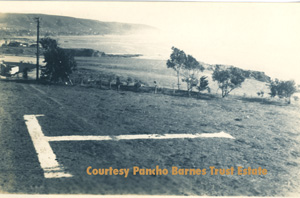
Delivering the rotgut was easy to do, because shortly after she'd gotten her pilot's license, Pancho had a runway graded onto her property -- which perhaps qualifies it as Laguna's first and possibly only airport. The neighbors hated the noise of the Travel Airs and Stearmans flying in all the time, but nothing could be done about it as there were no regulations in those days. Pancho's home also boasted a large swimming pool, and guests including Wallace Beery and Ramon Novarro can be seen cavorting in it, in photos now in the collection of the Pancho Barnes Trust Estate. Some of them were likely shot by Hurrell, who dropped his paint brush and picked up a Kodak. It would be thanks in part to Pancho, that Hurrell later became MGM's chief portrait photographer. (See 07-15-07 Journal).
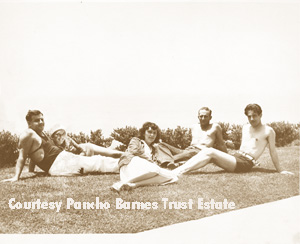
While many people in Laguna society shunned the spotlight in those days (and still do), Pancho seems to have been all about publicity. She sent photos of herself and important friends, both in and out of her pool, to a number of news services. Perhaps it was because she was having so much fun, she just needed to share. (One of the best images, which must have been slightly shocking for its day, shows Pancho in a tight one-piece bathing suit, lit cigarette in hand!)

Photo at left: Wallace Beery (left) and Ramon Novarro (right) lounge by the pool.

Unfortunately, it was publicity of the wrong sort that eventually dimmed Pancho's 10,000 watt party bulb. In July of 1930, a biplane flying into her Laguna airport suffered some kind of calamity, and dropped 200 feet into the bay. It took nearly an hour and a half for rescuers to locate the wreckage, which had sunk fifty feet below the ocean surface. When it was hauled up by grappling hook, the pilot was identified as millionaire sportsman Maurice Dodds. He and his passenger, a Union Oil Company representative named C.F. Lienesch, appeared to have been killed instantly on impact. Dodds' parachute showed no sign that he'd tried to use it.
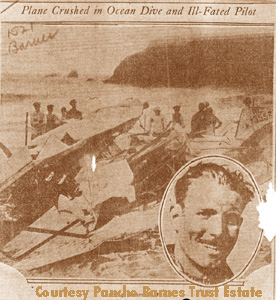
The cause of the crash was impossible to determine. Pancho and several witnesses firmly believed that Dodds' engine had failed in flight. Other parties speculated that the biplane had hit an air pocket, and suggested that these kind of down drafts were common along the coastline. In the end, this view seems to have forced the closure of Pancho's airport.

Even if the crash had never occurred, Pancho's days in Laguna were numbered. Strapped for cash by the othercrash -- on Wall Street -- she eventually had little recourse but to sell the property and move on. (See previous journal entry for more about Pancho and the Great Depression.)

Press Coverage

Print Email

Synopsis

Print Email

ASBxTJoeJones2he Legend of Pancho Barnes chronicles the thrilling life and extraordinary times of aviation pioneer Florence Lowe "Pancho" Barnes, one of the most colorful and accomplished women pilots of the earliest 20th Century, and an ill-behaved woman who made history.  

Born in 1901 into a wealthy Pasadena family, Florence Lowe was expected to be a debutante.  She chose instead to become a tomboy and a rebel.  Her desperate parents arranged a marriage to a minister.  Florence responded by disguising herself as a man, and running off to war-torn Mexico.  She emerged months later full of wild stories, and with the nickname “Pancho”.  

In 1928, Pancho decided to become a pilot for the thrill of it. Aviation soon became her profession.  She was hired as a test pilot by Lockheed, and flew in the first Women's Transcontinental Air Race in 1929.  She broke Amelia Earhart's air speed record, and was the first woman to take wing as a Hollywood stunt pilot — for Howard Hughes no less.  It was a risky business, especially for a woman, but Pancho thrived on the danger.  “If I didn’t fly,” she once told a stunned reporter, ”I’d explode.”

The Great Depression put a damper on Pancho’s flying career, and her extravagant lifestyle.  She was forced to flee Hollywood in 1935, and ended up in the Mojave Desert, near an Army Air Corps bombing range called Muroc.  During WWII, Muroc (later called Edwards AFB) became an important aircraft proving ground. Pancho and her ranch became the social center of the place.  

Known as the "Happy Bottom Riding Club", Pancho’s ranch was a notorious, boisterous hangout frequented by some of the most important fliers of the post-WWII era.  Pilots such as Chuck Yeager and Bob Hoover drank at her bar, and when Yeager broke the sound barrier in 1947, that’s where he partied.  Just a few years later however, things began to go downhill.  Allegations surfaced that the Happy Bottom was a house of ill repute. The FBI began an investigation, and because of her wild, larger-than-life personality, Pancho found the accusations hard to refute.  Meanwhile, as legal proceedings were underway in 1953, a mysterious fire destroyed the ranch.  Many believed, the fire signaled the end of an era.

This is the story of a larger-than-life figure, a fully liberated woman in an era when few dared challenge convention — and the price one person paid for living outside of it.  

This project features newly discovered documents from Barnes’ personal files, never-before-seen photos, and rare movie footage to tell her story, and features interviews with her friends, historians and biographers.  

Frequently Asked Questions

Print Email

ASBxFREQUENTLY ASKED QUESTIONS ABOUT
THE LEGEND OF PANCHO BARNES
and the Happy Bottom Riding Club


1. Where can I see the film? Where can I buy a copy of the film on DVD?
A 58-minute version of The Legend of Pancho Barnes and the Happy Bottom Riding Club is now airing on public television stations in the USA and in countries around the world.  You can also see it on the Air Show Buzz website, click here.  The original, extended version of the film which is seven minutes longer and "uncensored", is appearing at film festivals throughout North America.  See the screening schedule in the menu for more information. You may purchase a DVD that features BOTH versions of the film via this website using the "Buy DVD" link.

2. Will the film air on television? What if I don't have access to TV?
Yes. A 58-minute version of the documentary is currently airing around the United States via American Public Television, a public television network.  The film will also be streamed on the Air Show Buzz website www.ASB.tv so, if you don't have access to public television or live overseas, you can still see it!

3. Who made this film?
The filmmaking team consists of writer/producer Nick Spark, director Amanda Pope, associate producer Nathan May, and associate producer Dr. Dydia DeLyser. Nick is a documentary filmmaker with an MFA degree from the University of Southern California. He produced, wrote and directed Regulus: The First Nuclear Missile Submarines that appeared on Discovery Channel Europe, and his work as a student received two Emmy Awards. Amanda Pope’s long career includes work as a director and producer for PBS, and as a professor at the University of Southern California. She directed Jackson Pollock: Portrait for PBS and co-produced the Stacy Keach film Wilbur and Orville. Her new film The Desert of Forbidden Art will debut on PBS in 2011. Associate Producer Dydia DeLyser is a professor at Louisiana State University, who is known for her work in the field of women’s aviation history, and associate producer Nathan May is a very private fellow.

4. How was the film financed?
The documentary has been financed entirely through donations to the KOCE-TV Foundation, a 501(c)3 non-profit. Donors included private individuals, foundations, and granting organizations. The documentary has received some of these moneys from competitive grants, including the Wolf Aviation Fund, Lincy Foundation, Women in Film Finishing Fund, Clay Lacy Foundation and Pacific Pioneer Fund.

See our donors list, available through the menu, for a full list of our supporters.  Thanks to one and all.

5. Has KOCE-TV / PBS contributed to the production costs?
No. KOCE-TV has only been involved solely as an entity that manages the donations to the project, and oversees the management of the account. KOCE-TV has also provided some oversight for the production, and has reviewed cuts of the film on a periodic basis.

6. Why did you choose to make the film on a non-profit basis?
Making a documentary film like this one is an expensive proposition. We knew from the start that it would be unlikely that we could recover those costs from sales. Documenting history is rarely a money-making enterprise, and while a network like the History Channel is a for-profit, the quality of their programming varies because of the amount of time and cost they are willing to use to support their productions. The Legend of Pancho Barnes has been produced with high production values, and at relatively low cost. Incidentally, similar PBS productions, such as the films made by Ken and Ric Burns or “The American Experience” series, often have per-episode costs of over a million dollars. (Ken Burns’ Baseball cost roughly $750,000 per episode). Our final finished cost will be less than ¼ of that.

7. I know someone who knew Pancho. Should I put them in touch with you? People who knew Pancho frequently contact us. After all, she was a public figure who came into contact with many people throughout her lifetime – and she made an impression. The film is at this time completed, so we’re no longer looking for people to interview for it. That being said, we’re always interested in learning more about Pancho!

8. Who is the Pancho Barnes Trust Estate and how are they involved in the making of the film?
The Pancho Barnes Trust Estate is a privately-held entity, that controls the rights to Pancho Barnes’ name and likeness. The Estate has granted permission to the filmmakers to make the film, and has supported their efforts by giving them access to materials in the Estate and the archive it maintains. The Estate has not provided any financial support for the project, has not had any creative control over the project, and will not benefit materially from the production of the film. The Estate has licensed Pancho’s name and likeness for a variety of products and ventures through Pancho Barnes Enterprises, a California corporation.  Visit the links page for more information and to visit their website.

9. What do you hope the impact of the film will be?
The film explores not just the life of Pancho Barnes, but an entire era in aviation history. It recaptures, at least in part, the spirit of both the “Golden Age of Flight” in the 20’s and 30’s, and the “Golden Era of Flight Test” in the 40’s and 50’s. Both were time periods in which people did courageous things, in the name of advancing aviation. Pancho was a part of all that, and it is our hope that the film will inspire people to explore that history further, and celebrate it.

We sincerely hope The Legend of Pancho Barnes will speak to a broad audience, and inspire them in other ways as well. For women, especially young women, the film can be empowering. Pancho is not a role model in some respects, but in others she certainly is: she was, after all, a forceful woman who did things few people ever dreamed of doing, and who persevered despite steep odds.

Pancho’s accomplishments were real ones, and she achieved them in a world dominated by men. She did that, despite the fact that she was not a model or movie star. In fact, she did it entirely because she wasn’t one. The film will clarify her role in history, and change some misperceptions about her, and hopefully restore her to her rightful place in the pantheon of aviation.

10. Who would I contact to find out more about the project, or answer questions about it?
Producer and writer Nick Spark is the point person for most questions. He can be reached via this website.

Legal

Print Email

The name and likeness of Florence "Pancho" Barnes are copyright by Pancho Barnes Enterprises, Inc. and are used with permission. "Pancho Barnes", "The Happy Bottom Riding Club" and affiliated logos and other materials are registered trademarks of Pancho Barnes Enterprises, Inc. and are protected by law. Used with permission. Some photographs and other materials appearing on this website are owned by third parties, as indicated, and are used with permission. This web page and all contents, including text and graphic elements, and the title The Legend of Pancho Barnes and the Happy Bottom Riding Club are copyright 2008-2009 by Nick Spark Productions, LLC. All rights reserved. None of the contents of this or any other page in this website may be reproduced, reused, published, altered, sold or modified without express permission of the copyright holders. For more information about Pancho Barnes Enterprises, please visit their website.


Facebook Box

You Can Help

Your tax-deductible donation can help make "The Legend of Pancho Barnes!" a reality.

:

News Letter

APT
The Legend of Pancho Barnes and the Happy Bottom Riding Club ©2008-2010 Nick Spark Productions, LLC.