
Saturday, October 24, 2026

Last Updated: Wednesday, 12 August 2015 04:31 16 May 2008 Nick Spark Hits: 4693
Last Updated: Wednesday, 12 August 2015 04:31 15 May 2008 Nick Spark Hits: 5335
 We're pleased to announce that "The Legend of Pancho Barnes and the Happy Bottom Riding Club" has won the 2008 Women in Film Finishing Fund grant. This prestigious $5K grant will help cover some pressing costs, and get us one step closer to done. "Pancho" was one of only six films in the entire country to be honored with this grant. Want to make a gift of your own? Click the "donate" button above!
Last Updated: Wednesday, 12 August 2015 04:31 14 May 2008 Nick Spark Hits: 4554
 The very last interview conducted for the Pancho film was with, who else?, a remarkable woman.
Bondi Abraham grew up in the Mojave Desert during the late 1940's and early 50's. Her father, Henry Winters, actually was the man who officially claimed the Muroc Dry Lake as U.S. Government property, and one of the five men who set up what would eventually become Edwards AFB. Winters was taken with the area. Soon after he left the Army Air Force to work for Lockheed in Los Angeles, he quit and returned to the Mojave. Clark Gable owned a large hunting lodge near Muroc named Rancho La Berenda, and Winters and his family lived there as managers, while running their own spread. Later, after Gable died, they bought the place.
Clark Gable's hunting lodge was not that far away from Pancho's spread, and she and the Winters lived as western neighbors do, helping one another get by in tough times. "We'd help her with the mustangs, " remembers Bondi, "and she would come over and help us with our castration and de-horning of the animals. All the people who lived around there would."
 Herding the wild horses was an especially exciting event for young Bondi. "Pancho would take me out and put me on a chair," Bondi recalls. "Then she and my father would drive the mustangs down right towards me. And here's Pancho on one side, and Daddy's on the other. She's pushing the mustangs away to make sure I don't get hit. But I get to see everything that's happening. All of them would pass, and then she'd break away and come back, pack me up, and I'd go on the back of her horse. And I'd hang onto her and we'd start breaking the mustangs little by little."
Photo: Pancho holds Bondi in her lap, circa 1949.
Clearly, Pancho and Bondi had a special relationship, one that made a strong impression on the young girl. At the time she was in an awkward phase, and had a severe self-image problem. Pancho knew exactly where Bondi was, psychologically, and did what she could to let her know that. "The first time I ever met Pancho, I looked at her," Bondi notes. "And I didn't look at her as other people looked at her, and she knew that. She did equate to my homeliness, and she wanted to let me know that it was all right, and that some day it might be different. And that's how she formed my life for me. To me, she was a beautiful person."
 The Winter family's time in the Mojave was full of hard work, which not only included normal ranch life, but hosting hunters who came out to shoot geese and ducks. Every now and then something exciting would happen. On a few occasions Hollywood production companies arrived to shoot something else -- movies -- in the desert nearby. The Winters hosted stars like Roy Rogers, Tim McCoy and even Ronald Reagan. "They'd bring him home and we'd chit-chat," says Bondi. "Ronald Reagan was a neat person. And we met an actress who was later on the Waltons. She did all her own stunts, and she'd come over and borrow Pancho's buckboard. They set her up there and taught her how to drive a team of horses."
Photo: Bondi and her brother Michael outside the family's ranch in the Mojave. Clark Gables' former hunting club, which the family also occupied, was down the road a ways.

There were some uninvited guests, too. After Pancho had expanded her alfalfa farm and dairy into a full-blown guest ranch, visitors often confused Rancho La Berenda with Pancho's. "The service men would go to town and drink, and they wanted to have entertainment." says Bondi. "We were always told, if there was a knock on the door in the middle of the night, not to answer the door. Sometimes things would get a little hairy and Dad would have to come out and address the issue."
While difficult, life in the desert seemed idyllic to Bondi and her brother Michael. But, when the government decided to expand Edwards Air Force Base, it all came to an end. For a time ranchers like Henry Winters and his neighbors tried to protest the government's seizure of their properties. Pancho of course was the most vocal of the bunch, going so far as to actually sue the government.
 In the middle of the suit, and a federal investigation, part of Pancho's guest ranch burned to the ground. It was a terrible day, one that Bondi will remember forever. "You have to remember that the Muroc Dry Lake is flat and reflective. So you see things coming off of it. I saw the big fire," Bondi recalls, her voice quivering. "(Panco) came over (to my father) and said, 'Aw, Henry, it's gone. And I can't go on anymore I just can't do it anymore, I'm going to let them have it." Bondi pauses and then says, "It's not fun to see a woman like that. That defeated. Because she was totally defeated. She had taken on the United States Government and they had won."
Despite what she may have said that day, Pancho did not give up. Although she did eventually lose her ranch, Pancho won a larger settlement than any other person in the area. By then however, Henry Winters and his family had moved on, and Clark Gable's hunting lodge was bulldozed. Bondi's memories of the place faded, but not her affection for that time in her life, or for Pancho.
 "What she showed me and told me was," Bondi says, her voice breaking, "Even as a homely little girl… Someday if you go for it, someday if you keep trying, some day it will happen." It did for Bondi. A successful artist whose pieces are highly collectible today, she's lived an extraordinary life, and determined who she is and she's made of, on her own. Her verve, strong personality, and sense of herself are wholly reminiscent of Pancho.
"She was the type of woman that I wish we had today," Bondi says with a sigh. "She was not ashamed of her looks. She was good to everyone, and she accepted everyone for what they were or were not." She pauses, and then continues. "I wish the women of today had the strength and attitude that Pancho Barnes had."
Photo:Amanda Pope (l) interviews Bondi Abraham in summer, 2007.
Last Updated: Wednesday, 12 August 2015 04:31 18 April 2008 Nick Spark Hits: 5439
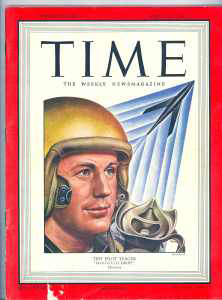 In the early spring of 1949, Time magazine decided to make Chuck Yeager its “Person of the Week”. It was a long-overdue gesture. Some fourteen months before, in April of 1947, Yeager had become the first man to break the speed of sound in an airplane in level flight. The Air Force kept the achievement secret for many months, before finally acknowledging it in December of ‘47.
Time dispatched one of its best photographers to provide visuals for the article, entitled Man in a Hurry (click to read it!).
Although he was still in his twenties at the time, Murray Garrett was no journeyman. During high school in the early 40’s, he’d worked part-time for Graphic House, a leading photographic agency. Just after the end of WWII, he was sent to Hollywood to open a West Coast bureau. He ended up shooting movie stars from Brando to Marilyn to Sinatra, and became Bob Hope’s personal photographer. Despite the glitz of Hollywood, he always enjoyed any opportunity to cover news, and was delighted to spend the day up at Edwards Air Force Base with Yeager.
 The test pilot turned out to be more handsome and dashing than Garrett imaged. “I was blown away by (Yeager),” Garrett remembered in a recent interview. “He was a knockout."
Yeager had a reputation, at the early part of his career at least, for being a little shy. But, that wasn't the case on this day. "I knew what he’d done," Garrett recalls, "and it turned out we were just a few years apart in age. We struck up an immediate friendship. I wasn’t awestruck, and he could relate to me age wise, and I could relate to him. Most test pilots, you had to kowtow to, because they were hot stuff. But Yeager didn’t have that attitude.”
So trust was not an issue between subject and photographer. The challenge for Garrett, as it would be for any shooter worth his salt, was to show the fastest man on earth in a way that would reveal a bit of his character, and portray him in a way that was both interesting and unique.
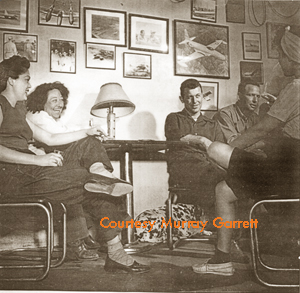
Photo (above left): Pancho and Chuck share a laugh at the Happy Bottom Riding Club. This photo appeared in Time in 1949. The names of the hostesses and the guest on the right are, alas, unknown.
“As I recall, we talked about following him around, doing a typical day,” Garrett says. Yeager took him on the flight line and posed with aircraft and in his flight suit. Then, the pilot brought him to his house, and introduced him to his wife Glennis and their children, and Garrett snapped photos. “Next, Yeager said to me, 'There is a woman named Pancho Barnes who is a kick in the ass and a real good friend',” Garrett continues. “He said, 'If there is any way, I would like to get some photos with her.' I remember, (Glennis) thought it was really stupid for us to go there.”
 Despite Glennis’ objections, the two men made their way out to Pancho’s ranch. The Time article would describe it this way:
Pancho's Fly-Inn (or the Happy Bottom Riding Club) … has its own airport, lighted at night, so that guests, friends and airborne wayfarers can fly in at all hours. The Fly-Inn is a much-buzzed place. Standing alone on the flat desert with only a few low trees, it invites the dangerous prank that all young pilots play, no matter what the threats of flying field managers or military C.O.s. Chuck Yeager has roared low over the ranch in every sort of airplane, including the fastest jets. When he buzzes the place in a jet plane, the slap from the zipping wing jounces the bar.
“I really wasn’t sure whether it was part whorehouse, part bar, part eatery, or what,” Garrett says with a laugh. “And Yeager wasn’t emphatic about spelling it out.”
Pancho was hospitable to Garrett, and he was immediately impressed by her rapport with Yeager. “He had absolutely a strong bond with her,” he remembers. “He was her boy, because he was a kid, really, and she was in her late forties.”
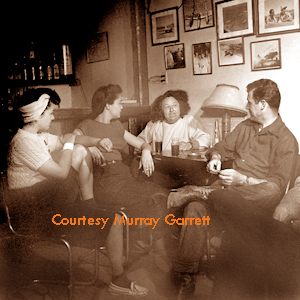
Photo (above right): A never-before-seen shot from the same set-up at Pancho's. (Below): Another set-up, this time with the piano. Pancho's boyfriend (and later fourth husband) Mac McKendry stands to her right.
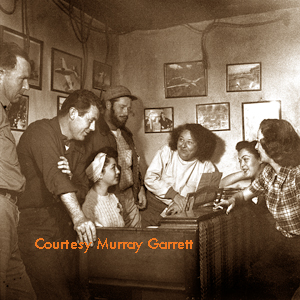 Yeager implored Pancho to pose for some shots, but initially she was cool to the idea. “I anticipated that she would be a tough customer,” Garrett says. “And she didn’t like the way she looked at the time. But, I got one or two shots. We rigged it up, and we tried to trick her into a couple things. That is why you see some of the weirdly composed shots.”
Only one of the photos at Pancho's ran in Time. The rest were put away, as part of Garrett’s collection of tens of thousands of negatives. Just last year, the pictures found a new home, when Garrett decided to donate them to the Academy of Motion Picture Arts and Science Library. Yep, the house of that famed golden fellow, Oscar.
“I had a decision to make about what to do with my life’s work,” Garrett explains. “And I got offered a lot of money to sell my collection. But at some point I realized that if I did that, they would stop being my photos. AMPAS doesn’t sell photographs, and they treat them with reverence. So, I made a contribution.”
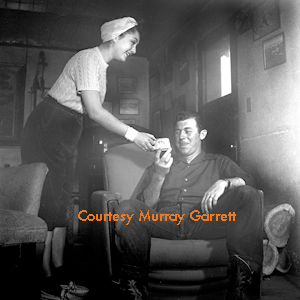 Thanks to Garrett’s gift, the photos of Pancho and Chuck are in the AMPAS archive, along with things like Jack Warner’s personal papers and Clark Gable’s contracts. With Garrett’s permission and the assistance of AMPAS staff, we were able to locate and then print up some of the “never before seen” photos from the day Garrett and Yeager spent together. They provide a window back in time, and portray Pancho and Chuck Yeager’s friendship in a wonderful, forthright fashion.
You can read about Murray Garret’s amazing career at his website, MurrayGarrett.com There are now two wonderful books featuring his amazing photographs of Hollywood stars in print: Hollywood Moments and Hollywood Candid. You can find them here.
Photo (above right): Chuck Yeager gets a little attention, as he relaxes with a cup of coffee at Pancho's place.
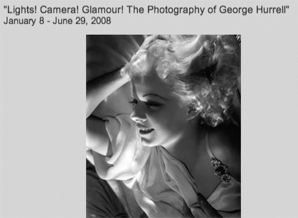 Speaking of Hollywood photography… Pancho’s friend, MGM chief portrait photographer George Hurrell is the subject of a retrospective show at Santa Monica’s California Heritage Museum link.
The show, which runs through June 29, showcases some of George Hurrell’s astonishing portraits of Jean Harlow, Joan Collins, Clark Gable and yes, Pancho herself. The show was organized by none other than our own Lou D’Elia (see 7-15-07 Production Journal). Ironically the Museum is right in line with the flight path of the former Clover Field Airport (now Santa Monica's municipal airport), so perhaps Pancho flew over it back in 1929! The show incidentally, is terrific and definitely worth a visit.
Last Updated: Wednesday, 12 August 2015 04:31 17 April 2008 Nick Spark Hits: 4086
 The fourth day of the Power Puff Derby spanned three states. The fliers started in Douglas, Arizona, and then flew to Columbus, New Mexico, before crossing into Texas and visiting El Paso before going on to Midland.
The emotions that the participants now faced are hard to know. As they flew East, they went farther and farther away from the site where Marvel Crosson had died, but the sense of her absence was omnipresent. The tragedy surrounding that sad event would be hard to shake, as would the uncertainty with regards to the cause. The women had complained earlier in the race that their planes were being sabotaged, but it was only after Crosson crashed that organizers took them seriously. Now, organizers promised, armed guards would protect the planes on the ground at each stop. That was something, but probably did little to reassure the pilots, whose lives were on the line.
The flight into New Mexico was over the desert, and dehydration was a real issue for everyone, even Earhart in her Vega. By the time the first women neared the Rio Grande however, the weather had changed from sunny to overcast. A summer storm had whipped up and visibility quickly plummeted. The race was cut short, and everyone was unexpectedly forced to spend the night in El Paso.
One benefit of the unexpected stop, was that Pancho and several of the other women had the opportunity to cross the border into Juarez. For Pancho, who had run away to Tijuana as a school girl, and who traversed much of Mexico on foot in the late 1920’s, South of the Border was home. She probably had a couple of margaritas, or at least a local cerveza or six, before bedtime.
 Whether she was nursing a hangover or not, the next day would be a bad one for Pancho. It began with her plane's engine having a mechanical problem, which forced her to turn around after take-off and return to El Paso. As a result she was late getting into Pecos. The town, had a population of about 3,000 people in 1929 (it now has roughly 9,000), and just about everyone was at the airport to watch the racers land. Spectators parked their autos at the side of the runway, and mobbed the small, improvised field, creating a dangerous situation. It was similar to what had happened a few days earlier (see 3.26.08 journal). For whatever reason, race organizers hadn't learned a lesson from San Bernardino, and it was Pancho who would pay the price for their lack of action...
Pancho didn’t see the accident coming for a number of reasons. “The Travelair did not have very good forward visibility,” she’d later explain. “And I couldn’t see directly ahead. As I came in there, someone drove their car across the field, right in front of me!” The car slammed into her plane, causing it to make a ground loop. The driver then quickly drove off the field, and disappeared, leaving spectators in a panic. Fortunately, as Pancho made her way out of her plane, it was clear that she was uninjured. The plane was not so lucky, though: the right side was a shambles. She’d have no choice, but to withdraw from the race.
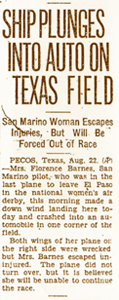 The contest would continue without Pancho, for four more grueling days and 1600 more miles. In the end, five other women would be forced out of the competition. But, despite all the odds and the nay-sayers, fourteen women managed to reach the finish line. Louise Thaden won the heavy aircraft class, and Phoebe Omlie took home the light class trophy.
It may sound corny, but in a very real sense, everyone who participated in the race was a winner. Even Marvel Crosson. Her death was not in vain, by any means, and she died doing what she loved to do -- fly.
The Powder Puff Derby would have an impact, and change things, in subtle ways, in the coming decades. Clearly, the success of the race, and the courage of the women who flew in it, made headlines and changed opinions. “This was the first time that young girls got to see that women could fly,” Gene Nora Jessen says. “And that they could, too.” The next generation of aviatrixes and the Womens Air Service Pilots, would owe their own ground-breaking opportunities to the courageous pioneers who flew in the inaugural Powder Puff Derby.
Postscript: Pancho borrowed a plane, and flew to Cleveland in time to see the 1929 National Air Races, and joined her fellow aviatrixes there. It was during that trip that she first saw the Travelair Mystery Ship, the plane that would later become so intimately identified with her (see 1.17.07 entry). According to Barbara Schultz’s biography Pancho, PB would have other opportunities to fly in the Powder Puff Derby, including 1930 when she attempted to enter her Mystery Ship in the competition. Unfortunately, the race rules were written in such a way that the MS did not qualify, a situation that outraged Pancho. She did fly in the 1931 race, but quickly fell behind in the standings. This time she made it to Cleveland, but she never contended for first place.
Last Updated: Wednesday, 12 August 2015 04:31 13 April 2008 Nick Spark Hits: 4868
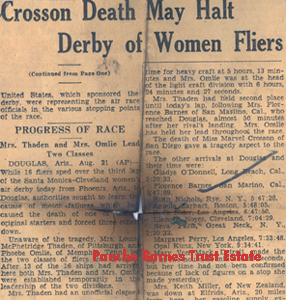 Day three of the Powder Puff Derby was the toughest for the competitors, and not because of the course, which ran from Phoenix to Douglas, Arizona. The papers on that day, August 20, 1929 announced grim news. It threatened to derail the race entirely: “Marvel Crosson is Killed When Plane Crashes in Arizona.” Reporters seemed to delight in the awful details, noting that Crosson “plummeted to a rocky, mesquite-grown Arizona hillside Monday under a partly-opened parachute” and that her “broken body” was being sent back to her family’s home in San Diego (see 9-16-07 entry).
Crosson’s death came on the heels of numerous accusations, regarding planes being tampered with (see previous entry). Many of the racers were convinced Crosson, who was one of the most experience women pilots, had fallen victim to sabotage. Pancho was among them. “I roomed with Marvel,” she explained later. “And she was very worried. She said something was wrong with her airplane, it was sabotaged.” The truth is impossible to know. Perhaps Crosson’s plane was tampered with, perhaps not. Like many other racers, including Pancho, Crosson flew a Travel Air biplane equipped with a J5 engine. While the plane was known to be highly reliable, designer Walter Beech recognized it did have one flaw. Carbon monoxide from the engine could pool in the cockpit in certain circumstances. In fact, Beech had rigged up a piece of pipe in Louise Thaden’s ship, after she complained of symptoms that were in line with carbon monoxide poisoning. In Crosson’s case, she flew a racing model of the plane, with a smaller cockpit that most. She was short, and as a result possibly even more susceptible to the dangerous effects of the fumes.
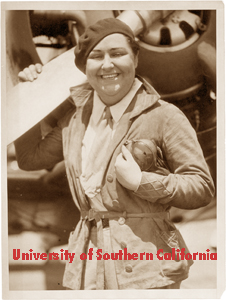 Whatever the cause of the accident, it set off a firestorm. Some men in the aviation business world, including Earle P. Halliburton, called for an end to the competition (see 2-22-08 entry). The New York American declared that the race was “undermining public confidence in aviation” and noted in melodramatic fashion that “a fine young woman has been called as a sacrifice on the altar of premature competition. Air racing for women, should be discouraged as a far too hazardous adventure.” That may have been the attitude of the press, but not the contestants. Every one of the women were convinced it should continue. “News of the death was shocking and depressing,” Pancho noted, “But it didn’t daunt the courage of a single flyer.” According to Gene Nora Jessen's book The Powder Puff Derby of 1929, racer Mary von Mach took a leadership role in rallying the group. "If I had crashed and were unable to go on," von Mach told the assembled women fliers, "My worst nightmare would be that I had caused the race to stop. Marvel would want us to carry on where she left off."
Photo: One of Pancho's publicity shots, probably from the second or third Powder Puff Derby. Nice tie, Pancho!
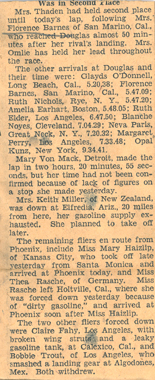 The women did not take a day off to mourn, but resolutely resumed the race after a two hour postponement, taking off at 8 a.m. instead of the scheduled 6. As the racers departed Phoenix’s Sky Harbor Airport and flew on to Douglas, they left little doubt that the race would be completed. Crosson’s death was a tragedy, but it would not be allowed to interfere with their mission. The race was no longer just a novel competition, but a symbol of the ability of women to achieve, to overcome, and to persevere.
By the time the last flier arrived in Douglas, a new sense of spirit and camaraderie had emerged. Pancho contributed to it, and did her best to keep a positive outlook, and keep her friends going. During the Yuma to Phoenix portion of the race, she had inadvertently flown South of the Border and into Mexico. That was a stunt repeated by several other contestants during the Phoenix-to-Douglas leg. Seeing an opportunity to have a little fun and put smiles back on the faces of the other women, Pancho got some paint and scrawled “Mexico or Bust” on the side of her plane.
Unfortunately for Pancho, what would happen to her in the next leg of the race would be no laughing matter.
This newspaper clipping, from Pancho's personal scrapbook, features late breaking news from the Derby. Louise Thaden won the heavy aircraft class, flying into Douglas a full 50 minutes ahead of Pancho. Not everyone made it to Douglas. As the article notes, Mrs. Keith Miller, an aviatrix from New Zealand, ran out of gas 20 miles from the airport, and Bobbi Trout smashed her landing gear during a landing in Mexico.
(Want to read more? Check out an article written by Gene Nora Jessen at: the Ninety-Nines website.)
Your tax-deductible donation can help make "The Legend of Pancho Barnes!" a reality.


 O-Sense