
Saturday, October 24, 2026

Last Updated: Wednesday, 12 August 2015 04:31 03 April 2008 Nick Spark Hits: 4465
 I believe I left off the last entry noting that Pancho had flown into San Bernardino, the first leg of the Powder Puff Derby, in first place. That is only a half-true statement! In reality, there were two classes of aircraft in the race: light planes and heavy planes. Pancho's Wright J5-powered Travelair biplane was considered a “heavy” plane, as was Amelia Earhart’s J5 Lockheed Vega. Bobbi Trout and Phoebe Omelie, and four other contestants, flew smaller, “sporting” planes with smaller engines. Omlie, in her Monocoupe, led the “light” plane class that first day.
Photo: Pancho, in her Travelair, gives the high-sign to the photographer. This photo was snapped at Clover Field, Santa Monica. Courtesy L.A. Public Library.
The second day of the race, August 19, 1929, would represent a real challenge. With summer temperatures reaching into the 90s and beyond, the women would fly nearly 400 miles from San Bernardino to Calexico, and then on to Yuma. The plan was to have an early start — 6 a.m. — and avoid the worst heat of the day. The light planes took off first, and then the heavy aircraft.
As Gene Nora Jessen writes in the definitive history of the race, The Powder Puff Derby of 1929, this second leg of the race was when it really became a race! The San Bernardino flight was so short that no real strategy could be developed. But this run, over the Banning Pass and Mohave Desert, presented several different routes. Louise Thaden, flying in a Travelair J5 similar to Pancho’s, flew between the town of Hemet and the mountains, riding a cushion of air up to 7,000 feet.
 It was during this hop that trouble struck Claire Fahy (wife of Lockheed test pilot Herb Fahy, see 9-30-07 journal entry). Two of the wing wires on her OX-5 powered Travelair parted. Her initial reaction was that her plane was about to shed a wing, and she considered using her parachute and jumping for it. But then she reconsidered, lowered her air speed, and tried to reach Calexico. After she landed, she realized how close she'd come to crashing, and she became distraught. Wing wires don’t just break, and Fahy quickly reached a disheartening conclusion -- that some person or persons had deliberately weakened the wires.
The situation with Fahy's plane was, sadly, not unique. Even before the race started, German pilot Thea Rasche had warned her fellow contestants about the threat of sabotage. A short time after Fahy’s problem, Rasche encountered her own. Her gasoline clarifier was discovered to have debris in it, and her gas lines were fouled. The problem caused her to make an emergency landing, that damaged her plane. She was unhurt, but recognized that in a different circumstance she could easily have been killed.
 It's possible that the defects Rasche and Fahy encountered could be explained, simply by the fact that the planes of this era were fragile beasts. Certainly that was how the organizers of the race tried to spin things. But, a threat certainly existed, and it is easy to believe the damage was intentional for two reasons. First, this being the 1920s, there were certainly men who objected to women doing anything but working in the home. By becoming pilots, and competing in a “man's world”, these women had made themselves targets. Second, air races were known to attract bettors. It may seem hard to believe nowadays, but a lot of money probably changed hands on each lap of the Derby. Influencing who might finish first, or who might not finish at all, could be very tempting to a certain element.

For Claire Fahy, the damage to her plane was a show-stopper. She quit the race at Calexico. The others continued on, including Pancho. By 8:00 in the morning she and many of the other women had reached Yuma, where the temperature had already reached 100 degrees.
As she flew on towards Phoenix, Pancho got disoriented, and began flying south of her intended course. Part of Pancho’s strategy in the Yuma-to-Phoenix leg was to follow the railroad tracks. Unfortunately, she’d picked the wrong ones. Finally, her suspicions got the best of her, and she set down in a farmer’s field. That’s when she learned, much to her chagrin, that she’d flown into Mexico. “They were yelling, ‘Hola! Hola!’” Pancho later recounted, “I wheeled around, goosed the throttle, and got outta there.”
 Shockingly, despite her Mexican adventure, Pancho managed to get to Phoenix’s Sky Harbor Airport before the early afternoon. It had taken her a little over three hours, twenty minutes from San Bernardino. By the time she landed, she must have been sun-baked, dehydrated, and dead tired. But, she must have also been quite happy. She’d made it and landed safely, and beaten everyone else to Phoenix. She was in first place, for the second consecutive day. She might have celebrated briefly, but more serious news developed as the day wore on. While by nightfall seventeen planes had landed at Phoenix, one pilot remained unaccounted for at the end of the day. It was Pancho’s good friend, Marvel Crosson (see 9-16-07 journal entry). She’d disappeared, somewhere between Yuma and Phoenix.
The Pasadena paper (above) reports on Pancho's achievement, and notes that she is "the grand-daughter of the man for whom Mount Lowe was named." The photo shows her posing with a Vega, and dates from her brief stint as a test pilot for Lockheed.
Last Updated: Wednesday, 12 August 2015 04:31 26 March 2008 Nick Spark Hits: 6421
 The first day of the Powder Puff Derby, August 18 of 1929, was a busy one at Clover Field (the present day Santa Monica Municipal Airport). It was an event of national importance, covered in all the newspapers and in the newsreels of the day. Fortunately for us, a number of these newsreels survive. One of them, from Fox Movietone, was shot using the latest equipment -- which is to say that the crew had the capability to record sound! It’s kind of extraordinary to consider that that sound newsreels were at that point only about two-and-a-half-years old. (One of the earliest, and most famous sound newsreels, incidentally, was Charles Lindbergh departing for Paris in 1927). If you watch our trailer (click on the link above), you will see some of this material, which runs for nearly an hour.
 This rare footage provides a window into what was, in its day, one of the most important women’s events. The “star” of the show was clearly Amelia Earhart, who thrilled the crowd when she landed her Lockheed Vega at the airport. She was given a wreath of flowers in recognition of her flight across the Atlantic a year earlier. Ruth Nichols, who had learned to fly in 1922, was also interviewed at length. Reporters wanted an explanation of exactly what happened in a “close call” she’d suffered on her way to Santa Monica. If they wanted drama, they got none of it, as Nichols downplayed her troubles. Nevertheless, the specter of danger was present at the race. Like anything having to do with aviation in those days, things could happen. “Flying back then was 10% machine,” Lauren Kessler notes, “and 90% guts.” All these extraordinary women who participated, clearly, had the guts!
Pancho, of course, stood out from the crowd. She also made good fodder for the press. “She was loud,” noted Gene Nora Jessen,” and she had a vocabulary that would put a sailor to shame. But the other women pilots really liked Pancho.” While all the other women pilots managed to doll themselves up for the press, Pancho showed up at Clover Field wearing a leather jacket and jodhpurs. It led the newsreel announcer to quip, “Florence Barnes, best known to the aviation world as Pancho. One of the greatest fliers to ever wear pants!” That brought a good-natured laugh from the fellow racers. (See photo in 3/07/08 entry).
 Joining the women at Clover Field that day was a huge crowd that included Tarzan author Edgar Rice Burroughs, who wished Marvel Crosson and Louise Thaden good luck. Howard Hughes, who had recently been nominated for an Oscar as producer of the crime drama The Racket, was also there. Perhaps the roar of all those planes helped inspire him to make Hell’s Angels? One can imagine who else might have been there…stunt pilots Roscoe Turner and Paul Mantz and Frank Tallman, most likely. Donald Douglas probably, since his airplane factory was situated on the field.
The first leg of the race was only a short hop, to San Bernardino, only sixty-seven miles distant. The intention was to let everyone get their bearings, and work out any kinks in the planes and pilots before venturing forth into the desert. Race Day 2 would entail a much more difficult trip of far greater distance, 348 miles to Phoenix, Arizona.
 The arrival of the women fliers in San Bernardino was greatly anticipated. According to Gene Nora Jessen, the local Exchange Club placed twelve-foot-high aluminum letters spelling out the name of the city on top of the local movie palace, so no one would accidentally mistake it for Chino (or any other town). One thing no one could have anticipated, were the huge crowds that showed up. As the nineteen competitors landed, four thousand spectators descended on the airport. They and their cars kicked up an enormous amount of dust, and crowded the field. It made landing difficult to say the least, and there were a couple of close calls. (It was a problem that should have gotten some attention by the race organizers, but did not, and with consequences later on...)
That evening, the women were wined and dined by their San Bernardino hosts. It was a very special evening for Pancho, as she got to show off a little in front of her fellow aviatrixes. The Flying Fool, the William Boyd movie that she flew stunts for, was shown as the final official event of the day. So, while she must have been exhausted by the day’s events, Pancho must have also gone to bed proud, and full of energy. She’d landed, incidentally, in first place.
Last Updated: Wednesday, 12 August 2015 04:31 26 March 2008 Nick Spark Hits: 5177
Last Updated: Wednesday, 12 August 2015 04:31 17 March 2008 Nick Spark Hits: 4877
When someone asked Amelia Earhart why she flew, she told them it was "For the fun of it!" That line became the title of her second book about her aviation career. While at first it seems like a flip remark, "for the fun of it" was actually a more complex statement. Aviation provided a feeling of joy and real liberation to the small group of women who dared become pilots in the 20's and 30's. In a time when most women were simply housewives, expected to be quiet and demure, creating fun in your life could be...revolutionary!
Flash forward about five decades... It's interesting to compare Earhart's remark with that made by Sally Ride, America's first woman in space. When she returned to Earth, Ride was roundly criticized in the media for saying that the flight was "fun". Somewhere up there, I guarantee Amelia Earhart and the women of her era, were terribly annoyed at the press' sentiment!
 In any case, if you want to get some insight into the unique group of ladies who flew in the Powder Puff Derby, look no further than the Santa Monica Morning Outlook, August 11, 1929. That issue of the paper featured an amazing, two-page article about the women fliers entitled "Why do Women Fly? They Speak for Themselves". The second page summed up a general sentiment with this headline: "Most of Us Fly Because We Would Escape from Social Stupidity...and to Make Money".
Albert Dorris, the reporter who wrote the article, seemed astonished that any women would want to make an eight-day trip cross country in an open cockpit, at the mercy of the weather and mechanical failures. The responses he got from the women he spoke to, however, must have convinced him they were a special breed. "Why do I fly?" said Marvel Crosson. "Because it is my profession, my way of earning a living and because I love it." Bobbi Trout put it this way: "Because I do it a lot better than I do anything else!", while Gladys O'Donnell answered, "My goodness! What a question!" She then went on to explain that she learned to fly after her husband took lessons, and that they were now partners in aviation as they were in life.
 For other contestants, the reasons that they flew were less clear cut. Vera Dawn Walker, who Dorris described as "an irrepressible 97-pound bundle of pep and ginger" shot back that she flew because "I want to". "It goes back to the time when I was just a little girl on a Texas ranch," she explained. "Even when I was a baby, I envied the birds. When I went to school, I was disappointed to learn I could not fly in the same manner." She went on, "In 1921, I was introduced to an aviator and told him my story. He invited me up for a ride..." and the rest, of course, is history. Or, I should say, herstory!
That response sounds completely idealistic when compared to the explanation offered by Ruth Elder, the Hollywood actress and aviator, who said she flew "because of the money there is in it for me." "I worked as a stenographer for $27.50 a week," she noted dryly, "and figured I could make a lot more than that if I could hop across the ocean. Lindbergh did it. Why couldn't I? You can say that Ruth Elder flies as a matter of business, just the same as she appears in motion pictures, for a stipulated weekly salary."
 Inevitably, of course, Albert Dorris interviewed Pancho, and got a "surprising" answer to his question. I have to say, that out of all the documents, interviews, personal letters, and ephemera that we looked through in assembling the film, the couple of answers Dorris elicited from Pancho are some of my favorite. Somehow, Dorris caught Pancho at just the right moment, when she was willing to do something she rarely did -- reveal a bit of her personal character and make-up.
"Why do I fly?" Pancho said. "To keep from exploding -- that's why I fly. It acts as a safety valve so far as I am concerned. It acts as a panacea for too many social duties, too much home management, too much everything conventional. It doesn't interfere with anything. Oh, there are thousands of reasons why I fly and I just love it."
Photo at right: Pancho, a "society lady and flier", as she appeared on the front page of the Outlook. The photo was her standard publicity shot at the time, and was probably shot by glamor photographer George Hurrell.
Last Updated: Wednesday, 12 August 2015 04:31 07 March 2008 Nick Spark Hits: 4685
 In May of 1929, Pancho lost her chance to set an endurance record with the Lockheed Vega (see 9.30.07 entry). It must have been a disappointing set back, for a woman who so badly wanted to make a name for herself in aviation. Just a few months later however, a new and exciting opportunity that seemed tailor made for Pancho, fell into her lap. It was the Women's National Air Derby, a race which would commence on August 18th, and pit some of the best female fliers in the world against one another. Competitors would begin at Clover Field in Santa Monica (the present site of the Santa Monica Airport) and fly cross-country to Cleveland -- nearly 2300 miles.
Photo: Cliff Henderson shows off his ten gallon cowboy hat, and a model of a billboard for the 1929 National Air Races.
The race was the brain child of aviation promoter Cliff Henderson, the father of the Bendix Trophy and creator of the National Air Races. Henderson might have been interested in promoting the role of women in aviation, but more likely he saw the women's race as a good publicity stunt. According to Gene Nora Jessen, the author of the book "Powder Puff Derby of 1929" (see 2.25.07 entry), Henderson initially proposed that contestants fly with male companions. "They said that men needed to be in the airplanes as co-pilots," Gene Nora told us, "Well, the women didn't like that at all. They wanted to do the flying. So, then [race organizers] said, the women could fly the airplanes and the men would just be their 'mechanics'." That led to more protests, since aviators like Pancho, Amelia Earhart and Gladys O'Donnell guessed that some entrants would rely on their 'mechanics' to fly their planes. In fact, that suspicion was proven to be true, as several Hollywood starlets signed up for the race initially. When the rules were changed so that only single women pilots were allowed, they dropped out!
 The women who signed up for the race were a veritable who's who. In addition to Earhart, Pancho, and O'Donnell, there was the holder of the women's altitude record, Marvel Crosson (see 9.16.07 entry). Phoebe Omelie, who had been the first woman to start an aerial circus, was there -- and walking with a cane as a result of a recent plane crash. There was Louise Thaden, who held the women's endurance record of 22 hours, and a speed record of 156 mph, and Ruth Elder, who had ditched her plane in mid-ocean in 1927 while trying to become the first woman to fly across the Atlantic. Thea Rasche, a German aviatrix and famed aerobaticist, was also in the mix.
Photo above: Race contestants (l-r) Louise Thaden, Bobbi Trout, Patty Willis, Marvel Crosson, Blanche Noyes, Vera Dawn Walker, Amelia Earhart, Marjorie Crawford, and Ruth Elder. Pancho (far right), stands out. She is the only one wearing pants and smoking a cigarette!

It was a quite a line-up, and since the race started in Santa Monica, race day was bound to attract some attention from Hollywood. "Movie stars were there," notes Gene Nora, "Like Howard Hughes. And Will Rogers was there! Will Rogers loved the women and it was mutual, they loved him too. He was very supportive of the women and aviation."
A keen observer of the scene, Will Rogers noticed that women pilots did something different than the men pilots. "When the women were being accosted by the press," Gene Nora explains, "They would always say, 'wait, stop!' And they'd get out their powder puff, and powder their nose. So Will Rogers had something to say about that. He said in his Oklahoma drawl, 'It looks like a Powder Puff Derby to me.'"
The name stuck. From that point on, the race would be known as the "Powder Puff Derby of 1929".
Photo: Pancho and Amelia Earhart pose in front of Earhart's Lockheed Vega at Clover Field. The woman in the middle is Elizabeth Grant McQueen, a socialite who promoted women in aviation.
Stay tuned for more Powder Puff Derby in the next Production Journal!
Last Updated: Wednesday, 12 August 2015 04:31 22 February 2008 Nick Spark Hits: 6959
Nowadays, you'd have to have been living under a rock not to have heard the name "Halliburton" in the press. Halliburton Energy Services operates around the world, and its former subsidiary, KBR, is heavily involved in oil production. In Pancho Barnes' day, there was another Halliburton frequently mentioned in the press -- Richard Halliburton. This dashing man was a well-known travel author and adventurer. In 1919, he'd temporarily abandoned his college career at Princeton to wander across parts of Europe. His first book, The Royal Road to Romance, described his travels and launched his career as one of the first "adventure journalists".
In 1931 Richard Halliburton hired Pancho's friend, pilot Moye Stephens, to fly him around the world. The Flying Carpet was both the name of the plane they flew, and the best-selling book by Halliburton that chronicled the effort.
 It's not exactly clear how Pancho met Halliburton, although it seems likely that she was introduced by Ramon Novarro, her movie star friend. The story goes that Halliburton was bisexual, and he and Novarro were lovers...
In 1933, Pancho and Halliburton met up in his adopted home town of Memphis, Tennessee. In an article headlined "2 Famous Adventurers Meet Again...Talking Over Thrilling Times", the two are presented as strong friends. At the time, Pancho was staying with fellow aviatrix Phoebe Omlie. (Uncharacteristically, Pancho was en route to Chicago and the World's Fair not by plane, but by car.)
"Pancho introduced me to Moye [Stephens]," Halliburton confided to reporter Ada Gilkey. "She advised me what kind of plane to buy, and helped me with many details of that trip."
Halliburton also noted that he'd stayed with Pancho in her home in Laguna Beach four months prior. While he was there, wouldn't you know it, the big Long Beach earthquake struck! There wasn't much damage to the house, although a chimney did tumble.
Halliburton, one can imagine, must have felt relieved and excited that he had one more thing to write about. For her part, Pancho chimed in that when the earthquake hit, she rounded up eleven members of the Women's Air Reserve Corps and rendered aid in the stricken area.
The fact that Pancho was driving cross country, and not flying, was the source of some amusement to Omlie and Halliburton, who did some good natured kidding about it. The reporter noted that their meeting ended with Halliburton showing Pancho his "newest possession -- a new Ford!"
 It very well may have been the last meeting between the two. Just about a year later, Pancho found herself in dire economic straights. She abandoned her flying career and left Los Angeles for the Mojave Desert. Richard Halliburton continued to work as an adventure journalist until 1939, when a Chinese junk he had built to travel from Hong Kong to San Francisco disappeared in a typhoon. Like Pancho's friend Amelia Earhart, Halliburton's body was never found.
There is another Halliburton story having to do with Pancho. The founder of Halliburton Energy Services and KBR, oilman Earl P. Halliburton, was no relation to Richard Halliburton. But, Earl P. was also an aviation pioneer. He not only maintained a fleet of planes for Halliburton Co., but he built Safeway Airlines. The name was inspired by the public's very real fears about early aviation. It was perceived to be quite risky and dangerous.
When the first all-women's transcontinental air race -- the "Powder Puff Derby" got underway in 1929, Erle P. Halliburton monitored it with some degree of concern. If one of the participants, such as Pancho Barnes, Amelia Earhart, Bobbi Trout or Gladys O'Donnell was hurt or killed in an accident, it surely would hurt the fledgling airlines like Safeway. Sure enough, when participant Marvel Crosson was killed in the third leg of the race (see 9.16.07 entry), Halliburton was outraged. He telegraphed the race organizers, and then called the papers and made remarks that were published throughout the country. "The Women's Air Derby is contributing nothing to aviation," Halliburton said. "It should be canceled immediately." Needless to say, Erle P. was probably not one of Pancho's favorite people!
Photo above: Earl P. Halliburton poses in front of one of the airplanes in his oil company fleet. By his feet is a set of luggage Halliburton popularized -- which are still sold today by the Zero Halliburton Co.
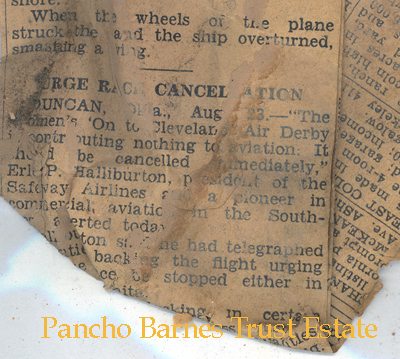 At right: newspaper fragment from one of Pancho Barnes' scrapbooks, held in the Pancho Barnes Trust Estate. In this column about events in the 1929 Powder Puff Derby, Halliburton's comments about the race are visible. The sentence above the "Urge Race Cancellation" headline, which concern a plane that struck and obstacle and somersaulted during landing, very likely refer to Pancho's crash in Pecos.
Your tax-deductible donation can help make "The Legend of Pancho Barnes!" a reality.


 O-Sense