
Saturday, October 24, 2026

Last Updated: Wednesday, 12 August 2015 04:31 12 November 2007 Nick Spark Hits: 4599
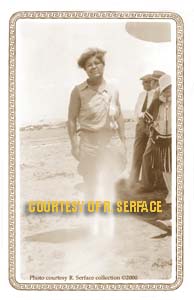 One of the delights, and difficulties, of making an historical documentary film is simply finding the documents and images you need to tell your story. For "Pancho", we've searched high and low, and in between, and found some amazing material. Never-before-seen photographs of Pancho will appear in our film, courtesy of a lot of private collectors, university archives such as UCLA and the University of Southern California, the Los Angeles Public Library, and other public and private institutions. Incredible motion picture film footage will debut as well, courtesy of private collectors, and a university archive. These are all things we've had to hunt for — that we've had to find. What's really, really neat, though, are some of the things that have found us.
Example: during the early stages of the project, I received a nice email from a woman named Roberta Serface. Turns out Roberta'd inherited the family collection of photographs, which included a series of shots of aviatrixes. Soon enough she sent us a photocopy sheet of her treasure-trove, which included a neat shot of Bobbi Trout at the Douglas, Arizona airport, and another with a familiar figure at Lordsburg, New Mexico. "Similar look to Pancho?" she wrote in the margin. Similar, indeed — because it is Pancho! That's the photo at right.
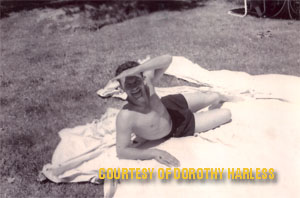 Another neat one, was an email from the daughter of a woman named Dorothy Harless. Turns out Dorothy had worked for Pancho at her Happy Bottom Riding Club in the early 1940's. She passed along some amazing stories about Pancho, and some rare photos of Pancho's husband Nicky (to right). Did I mention previously in the Production Journal that Pancho was married four times?! Nicky was #2. He was a student who enrolled in the Civilian Pilot Training Program that Pancho was running just prior to WWII. The two found they had a connection, but after a brief time the marriage broke up. No wonder: he was in his twenties, about the same age as her son Billy, while Pancho was nearly 40!
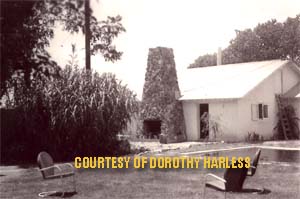 Dorothy's photos are quite neat because they show what Pancho's ranch looked like circa 1943. In the photo at left, you're looking at Pancho's house. To the right of the building is a rectangular swimming pool — quite a luxurious item to have in the middle of the Mojave desert in those days! At the left is a field of corn. It's especially neat to have this view, because we have some photos of Pancho posing with some notables, including Western cowboy movie star Roy Rogers, in front of this same crop. We'd always wondered where it was taken, until we saw this photo and realized, heck it was right in front of Pancho's house!
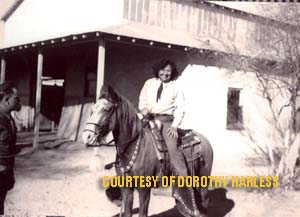 One of our favorite pictures from Dorothy shows Pancho on horseback, looking like the natural horsewoman she was...well, Pancho had her own Shetland pony stallion at the age of four-and-a-half. According to Dorothy, the horse shown in this photo was named "Frosty". Dorothy remembers some other horses as well. "Redskin" was an American Saddle Bred, who was "poetry in motion and a mean devil." This horse, Dorothy remembered, "liked to bite the toes of spectators in the exercise corral." One time Pancho intended to ride Redskin in a parade in Lancaster, about an hour away in those days by car. But, the horse simply refused to get into the trailer. It was a battle of wits, but sadly for Redskin he had underestimated Pancho. She mounted him and aggressively rode him all the way to town. They made the parade just fine and, Dorothy notes, Pancho had no problem getting him into the trailer for the ride home!
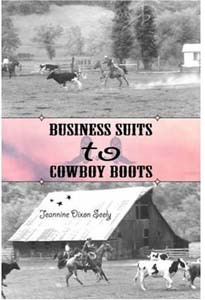 Another person who found her way to us, is Jeannine Dixon Seely, the daughter-in-law of aviatrix Patty Willis. To be honest, Jeannine didn't exactly stumble across us. More like, we found her! You see, Jeannine sells reproductions of prints out of Patty Willis' scrapbooks on eBay. We happened to see some of her wares, and sent her a note. In response, we got a pile of photo prints and a book, Business Suits to Cowboy Boots which Jeannine wrote in 2005. It's the story of her and her husband Lee, who left city life in Los Angeles and went to work on a 1000-acre cattle ranch. Incidentally, you can buy Jeannine's book on the web here
Anyway, Jeannine's book contains some neat recollections of Patty Willis, who learned to fly at age 19, and was a contemporary of Pancho and "boyish flier" Bobbi Trout. When Patty fell ill in 1984, Jeannine and Lee helped take care of her. One priceless story she recounts is that a doctor asked Patty to go to an office on Pico Boulevard and inquired, "Do you know where Pico is?" To which she replied, "Hell yes I do! I landed a plane on Pico Boulevard, so I think I can find it with my car." One can only imagine what the doctor thought about that!
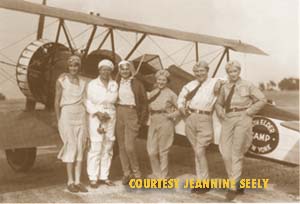 Here's a great photo from Jeannine that shows Pancho in her "Women's Air Reserve" garb, with Patti Willis to her right. Aviatrixes Mary Charles and Clema Granger round out the photo's left side, while Mildred Morgan stands on the far right. Note the "Ruth Elder Camp New York" emblazoned on the biplane!
"Contact!" -- Another great photo (possibly shot the same day, as the outfits and plane seem similar) shows Pancho, Patty and the rest of the gals about to pull an airplane
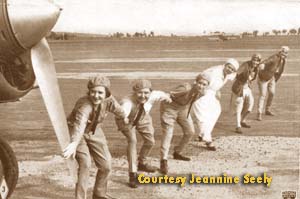 propeller. This image originally ran in the Los Angeles Examiner, and was typical of the 'gag' women flier photos of the day. It's a cute image, but an astute viewer pointed out that the underlying message seems to be: these poor gals don't even have the strength to crank a prop!
As if to make up for that subtly demeaning shot, Jeannine also sent us a nice photo of several of these very same gals, hanging from the Bendix advertising tower in downtown Los Angeles. They're actually at some lofty altitude, since the tower itself, perched atop a tall building, is itself 150 feet tall. It just shows how these womens' spirit could be summed up in one word: fearless.
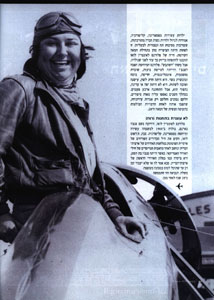 Finally, speaking of the wonderful people who've contacted us while we've been making the film, I have to put in a mention of the fact that we've had several nice mentions in the news media. The Orange County Register included a nice article about Patrice Demory, one of our interview subjects, some time ago. KOCE-TV hosted director Amanda Pope and myself on the show "Real Orange" last year, and this year we've supplied information and photos for a number of articles. It's always a pleasure to help spread the word about Pancho, the women fliers of the 20's, the world of the Happy Bottom Riding Club, and of course tell the world about our project. But you never know what is going to fall your way! So, anyway, it was rather neat to be contacted a few weeks ago by Sivan Gazit, who helps produce a magazine for the Israeli Air Force. Would we be willing to help with an article about Pancho? Of course! And now here it is, Pancho in Hebrew (left). I think she'd be quite proud — after all, many of the pilots in the IAF are women!
Last Updated: Wednesday, 12 August 2015 04:31 04 November 2007 Nick Spark Hits: 5670
 It's hard to believe that a mere six decades ago, Edwards Air Force Base barely existed. But like so many things in the West that seem to have sprouted up out of the dust, there it is. In the 1940's it certainly didn't seem like much. The Army Air Force used the dry lakes near the town of Muroc for a bombing practice range, and stationed men up there to build, and retrieve, concrete bombs. The men lived in absolutely primitive conditions, in tents, and braved the blazing sun during the day and the freezing cold that night on the desert can bring.
Photo: Army tents on the Rogers dry lake in the late 1930's...and pardon my spelling of courtesy!
In short, it wasn't a place you'd want to be posted. It was a backwards place... Perhaps it is appropriate then, to mention that it was actually named backwards as well! You see, the original family who started the homestead that became the town, were the Corums. Problem was, there already was a U.S. Post Office with the name of Corum, in Illinois. Rather than make a fuss, Corum, California became Muroc. So you see, a backwards name for a backwards place!
 The exact reason that Pancho ended up moving out to the desert, near where the AAF was doing its bombing, is something of a mystery. David Chisholm, who was one of the key people behind the fictionalized version of Pancho's life (see April 25th journal entry), told me he felt it was the biggest mystery of her life. Why would Pancho walk away from her career as an aviatrix in Los Angeles, and move to such a god-forsaken spot?
The answer that has emerged, is that she had to. Although she inherited around $6 million dollars in today's money in the mid-1920's, Pancho truly was broke by the mid-1930's. The Great Depression, a squabble with her relatives over her inheritance, along with her profligate spending on airplanes and assistance for her friends, proved her undoing. (Jimmy Doolittle recounted that Pancho turned her home into a pilot's hostel during the Depression — a move that couldn't have been cheap!) She had to leave Los Angeles because she couldn't afford to stay there.
The interesting thing is, that Pancho planned her escape to the desolate Mojave. Back in 1929, while preparing to set an endurance record with the Lockheed Vega, Pancho performed flights around Muroc. At that time, she spotted a beautiful alfalfa farm which she described as "luscious". She added that in her mind, the moment she saw it, "I made my mind up. One day, I'd like to get ahold of that ranch." She traded her last unencumbered possession in L.A., an apartment building, for the property.
 For Pancho, the Mojave proved a great escape — a place to rebuild her life and her bank account, raise her son Billy, and start all over again. For the soldiers who lived out there, however, it was a living hell. The fact that they hated it, is well-documented in a marvelous booklet entitled "The Battle of Muroc". This tiny tome consists of maybe twenty cartoons, written by a fellow named John McAtee. Doubtless, Mr. McAtee was one of those fellows who felt he'd been sent, not to an air base in California, but to Siberia.
 I had heard about this booklet — it's sort of a legend in its own right — and believe it or not managed to find an original copy for sale on the internet for cheap. The cover, shown above, shows a poor sun-baked fellow showing obvious signs of brain-rot, mumbling "I have been here too long".
One gets the sense, flipping through the acid-paper pages, that it came about simply as a result of a severe case of "gallows humor". Consider the situation: you are a young man, say 18 years old, stuck out in the middle of the desert. There's no bars, no bowling alleys, and no swimming pools. The heat is oppressive, and a bath or even fresh laundry is a luxury. Women? Forget it! And if you even manage to get a three-day pass, you're going to spend most of that time just trying to get to civilization. Keep in mind, Los Angeles may be a short hop by car nowadays, but in the 40's it was all dirt roads and no highways!
 As you can imagine, no one in their right mind would want to be posted out at Muroc. Apparently, people did everything they could to avoid it, and postings out to the base could be considered, shall we say, punitive?
Chuck Yeager, when we asked him to describe the Muroc he saw, when he arrived there in the mid-1940's, didn't mince words. "The base was really pretty sorry," he recounted. "Unfortunately, the people that were sent to Muroc, and were stationed at Muroc, were the dregs of the Air Force. They were really, from the commander on down, just about as sorry a bunch of people as you can get. You couldn't get the time of day out of these people."
Image above from Battle of Muroc: The caption is a bit hard to read, but this one says, 'Unhappy People." Image below, some of the pioneers pose in front of a building marked 'Radio Maintenance'. Judging from the outfits, it must be mid-winter.
 Of course, the situation did not remain as dire as all that, for long. Once WWII got into full swing, Muroc became an important facility for testing aircraft, and all sorts of talented people converged on the Rogers Dry Lake. Before long the base facilities improved quite a bit, although there were still a lot of primitive aspects to the place. For instance, the barracks got the label, "Desert Rat Motel" for reasons one can only speculate about. There was very little fresh food save the occasional jackrabbit, and the base recreational facilities consisted of maybe a volleyball net. As the old saying goes, when you live in the desert, "plenty of beach and no ocean..."
This is where, of course, Pancho came in. After losing her inherited fortune in L.A., she managed to make a new one, and a lot of it in government dollars. She bought a dairy, and supplied milk to the base. She raised hogs, feeding them trash she hauled from the base, and then sold pork cutlets to the Army. And...she provided what the poor fellows at Muroc really needed...some entertainment. "Back in those days," remembers pilot Bob Hoover, "You had an officer's club and you could go in there, and it would be completely empty. And, you had to go eat someplace else, because they didn't have any place to eat back then. In (the town of Muroc), there was just a couple of stores and a service station. And then," he says, a smile growing across his face,"...there was Pancho's. That was the watering hole for all of the test pilots and many of the support people. It was a very popular place."
 One of the reasons Pancho's "Rancho Oro Verde" was so popular, is addressed by my favorite cartoon in McAttee's "The Battle of Muroc" (at right). You see, even after they added some facilities to the base, there weren't many women to be found. Every now and then, during WWII, they'd bus some gals up from Los Angeles to dance with the Army boys, but that was about it. Of course, Pancho knew that having nice looking girls as waitresses would be good for business... Or, as she put it, they were the "honey to get the fly-boys" ! Which, funny enough, is sort of the exact opposite of this cartoon's gag!
Last Updated: Wednesday, 12 August 2015 04:31 24 October 2007 Nick Spark Hits: 6875
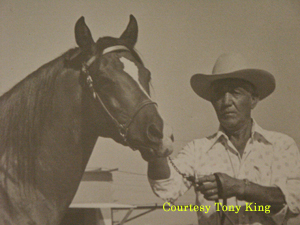 Jimmy Doolittle once said that Florence "Pancho" Barnes had a "heart as big as a ham." That certainly seems to have been true. During the Great Depression, Pancho took in a lot of unemployed friends, making her San Marino mansion into a veritable hostel. After she moved up to the Mojave Desert, her generous ways continued. She put up Chuck and Glennis Yeager and their family at her hotel on several occasions, and gave Yeager a motorcycle so he could more easily commute to the Muroc air base. She helped a man named Kirk Kerkorian and a woman named Babe Story get their pilot's license (he founded a major airline, and she went on to become a Women's Air Service Pilot during WWII). And, she helped a poor orphan boy named Tony King, practically adopting him as her second son.
"My dad died. My mother was dead," Tony King explained during a recent interview at his house near Cantil, California, "And I was just a little kid -- like a saddle tramp on horseback -- going from ranch to ranch."
Tony met Pancho in 1934, when he was only about 14 years old. He was riding a horse in a parade when Pancho walked up, and asked if he would mind if her son Billy rode his horse next to him. He didn't object, and at the end of the parade, she caught up to him. "She said, 'I hear you're just on the street'," Tony remembers. "And I said, "Yeah I have no place to go." Next thing you know, Pancho offered Tony a job working at her Rancho Oro Verde. It was a position Tony was grateful for, but one he undertook with a bit of trepidation. The hard-talking, swaggering, swearing, smoking woman called Pancho made quite an impression on young Tony. "Boy," he says, " "I looked at her, and said 'Wow!' -- she'll probably eat me up alive if I don't behave."
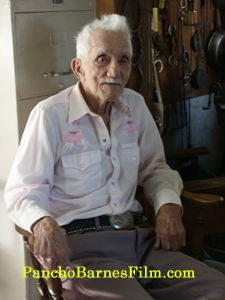 Tony's first day on the job was memorable. To get to work that day, he took an 8-mile ride across the open desert on horseback. That was a typical jaunt for Tony, who even at that young age was about one of the best horsemen in California. (He later was inducted into a regional Cowboy Hall of Fame).
When Tony arrived at the Rancho Oro Verde, he found Pancho in a panic. "I just barely got there," he remembers,"When one of the pigs was having piglets. And there was nobody around." Tony enlisted Billy Barnes' help. "So we got in the hogs' pen, and we were just lucky the hogs were gentle, because some hogs'll eat you up," Tony says with a scowl. "You know what I mean, fooling with their piglets. So every time she'd have a little pig, I'd rub it down a little bit and blow in its mouth. I'd take whatever membrane it had in it, and take it out, so it wouldn't choke to death. And I'd hand it to Billy, and he'd put it in a basket, and that was it. She had 8 little piglets."
That day, Tony proved to be a hero. In a short time, he was practically running Pancho's ranch. He was also, thanks to Pancho, getting an education. "Well, she made me go to school," Tony nods. "Right in her living room. She says 'I'll teach you your ABCs.' Billy was a young kid, going to school, too. I had to stay in there at least an hour and a half with the books. I could hardly speak good English. Nobody'd taught me, till then."
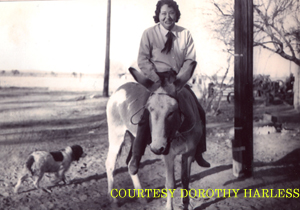 At the time Tony King met her, Pancho had only lived in the Mojave for a short time. She'd been driven to the desert by the Great Depression, which essentially wiped out her finances. She'd gone from being a Pasadena heiress and a woman-about-town, to a rancher running a hardscrabble alfalfa farm. Times were tough but Tony, who'd lived quite a hard life by then, barely understood what Pancho was going through. He did, however, appreciate her business sense, and played a role in transforming the struggling alfalfa ranch into something much grander. His hard work and sweat helped make it possible. "She bought a dairy out, called Adair," he recounts, telling a typical story of those early days, "And when she bought the place, I had to milk 'em by hand. There were 40 cows! I had to get up midnight and ride that horse two miles from Pancho's place to where the dairy herd was."
Photo (above right): Pancho Barnes circa 1946 at the Rancho Oro Verde
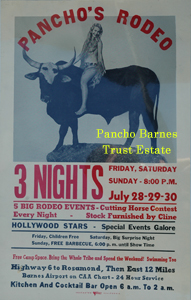 Tony remembers some wonderful stories about Pancho's ranch, especially the era when it was called "The Happy Bottom Riding Club." In fact, one of his stories is about how the ranch got it's unusual name. "Pancho had a horse called Happy," he remembers. "A black horse. And after they came in from a ride, this one guy said, 'Gee my ass hurts.' Wow! And he was riding a horse called Happy. So that's where the ranch got its name -- Happy Bottom Riding Club. Because this guys ass hurt. But he said, 'it's happy though.'"
Tony can also tell you about the time Pancho put on a giant rodeo at her ranch, and advertised it with an outrageous poster featuring a naked woman riding on a Brahma bull. "Lady Godiva," he laughs. "She had long hair that covered her all. I don�t know what she had underneath that hair! But it was a big bull - whoof! With a big hump on it - kind of gray. That was an attraction of the ranch, seeing that." According to Tony, at one of the rodeos Lady Godiva actually put in a live appearance during an intermission. "The crowd went kind of goofy, they liked that," he remembers, adding that thankfully, "The bull was always under control."
Between the Lady Godiva act and the name, "Happy Bottom Riding Club" -- which seems a barely-hidden a double entendre -- you might think that Pancho had a bit of a racy mind. When director Amanda Pope asked Tony King about that, he said flat out: "Pancho was man crazy, and proud of it. Men flocked around her, I don' t know why. She wasn't good looking at all. My feel looked better'n her. She was just a Pancho that's all. I don�t know how come cuz she was uglier than a mud fence. I'm glad she's not here to hear that or she'd tear me up."
 While there were many good times -- Pancho's wedding to her fourth husband Mac stands out in Tony's mind -- there were also bad times at the Happy Bottom Riding Club. Tony witnessed a terrible fire in the late 1940's that killed two of Pancho's stallions. "She had a 5-gaited show horse, it was called Santa Maria or Moreno, and we called it Red Skin, and she had a Thoroughbred gray called Tetraethel. After the gasoline. And they burned up." He also was there during Pancho's squabble with the Air Force, a battle that ended up in court and became known far and wide as the "War of the Mojave". Tony watched from the sidelines as Pancho's ranch was hit with another devastating fire, and then was seized by the USAF. It was a loss that hurt him deeply, too: after all, he'd worked hard to help build everything, and with his own two hands.
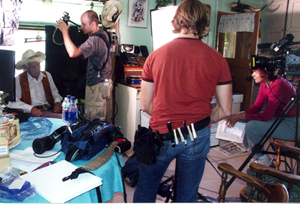
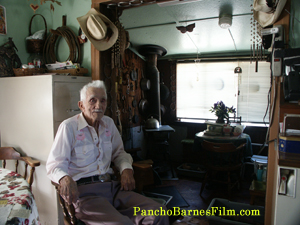
Photo (above left): Tony King (left) prepares for his interview. Director Amanda Pope is on the right.
 Perhaps Tony's saddest memories of Pancho, were towards the end of her life. After she lost the Happy Bottom to the government, and her fourth marriage went sour, Pancho's health deteriorated. She could no longer properly care for herself, or the horses she kept on her property at Gypsy Springs. "We went over there one day, it was her birthday, July 29th," Tony recounts. "She had nothing to eat. And the horses had no water. They had no hay. And they were going bananas, trying to get out." Tony tried his best to help, but eventually realized that the horses would be better off in the care of the neighboring Thunderbird Ranch. He helped turn them over to them. His friend Pancho, who had once owned dozens of horses and been master of the Riding Club, would never own a horse again. Soon, she would move from Gipsy Springs to the small rock shack in Boron, where she passed away.
It's a painful story to relate, and Tony gets choked up explaining the details. Still, he says, the good times outweigh the bad. "She treated me like a son," he says wistfully. "You know, Pancho was pretty important to me. She give me every Christmas anything I wanted. If I say I wanted them two calves over there, I'd get em for a Christmas present. She gave me a Thoroughbred horse called Jackie Payne, 'cause I liked the horse so well. That was another Christmas present. And you know," he says resolutely," a lot of people won't give you the stock they got."
Last Updated: Wednesday, 12 August 2015 04:31 16 October 2007 Nick Spark Hits: 5100
 "Pancho Barnes," author Lauren Kessler recounted during our recent interview, "lived at a perfect time and a perfect place. She lived at a time when aviation was just coming into its own, and when Hollywood was coming into its own. And when the connection between aviation and Hollywood was strong."
Indeed, aviation and the film business seemed intimately intertwined in the 1920's and 30's. Films with titles like "Air Mail", "Air Hawks", "Dawn Patrol", "Flight Angels" and "Wings" and "Hell's Angels" packed theaters nationwide, and inspired the aviation dreams of an entire generation. Just as the subject of aviation anchored many a Hollywood plot, airplanes changed how movies were shot, and created a whole new career — the motion picture stunt pilot. These were a special breed of men, and incidentally I do mean men, since with the exception of Pancho Barnes, there were no women stunt fliers in those days! (See 6/17/07 entry for the story of how Pancho started the stunt flier's union).
Poster at right: The feature Test Pilot starred three of Hollywood's biggest stars. Clark Gable played Jim Lane, a nervy flier who might be one of the best — if only he could stay sober!
 The stunt pilots were truly a band apart, the likes of which you rarely see today. I suppose some of the participants in the "X-Games" and some of the modern air racers have the kind of nerve, and sheer sense of recklessness, embodied by these fellows. Some of them were veterans of the Lafayette Escadrille and had flown in WWI in Europe — "lost boys" who knew life was cheap and had a Hemingwayesque disdain for the routine. Others came to find a career in stunt flying because normal flying wasn't thrilling enough. Frank Clarke, for instance, grew up on a ranch and might have become a rodeo cowboy had he not gotten bitten by the flying bug. Paul Mantz enrolled as a flying cadet in 1927 but was kicked out after buzzing a train; he soon found a career where such antics were not only encouraged, but they were the norm!
Photo: Goofing around on the set of Howard Hughes' "Hell's Angels", stunt pilots perform pre-flight checks on a machine-gun toting pony. Al Wilson, who mentored Frank Clarke, is at the far left, and Roscoe Turner just beside him. Clarke is behind the mare, second to Turner's left.

It's one thing to watch some of the great aviation movies of the golden era, and another thing entirely to read about how they were made. In many cases the stories are more compelling than the pulp fiction screenplays.
A wonderful book to get ahold of, is H. Hugh Wynne's The Motion Picture Stunt Pilots, published in 1987 by Pictorial Histories. It's out of print, but you can find used copies for sale on Amazon for around $10-15.
Wynne, who is now sadly deceased, was an architect with a passion for aviation history. He was one of the founders of Cross and Cockade, a WWI aviation historical group. He had unique access to many of the people who lived through the "golden era" of Hollywood stunt flying, including Moye Stephens, Dick Grace, Garland Lincoln, and others. He was also able to interview the son of stunt flier Leo Noomis, the daughter of Elmer Dyer, and the nephew of Al Wilson. The result is a book that is filled with anecdotes, many of them directly out of the mouths of the participants, and dozens and dozens of photos.
 Another excellent read is James H. Farmer's "Celluloid Wings", published in 1984 by Tab Books, and also out-of-print but available used. This encyclopedic work, which is just short of 375 pages in large 8.5x11 format, chronicles the impact of movies on aviation, and vice versa, from 1912's Mack Sennett comedy "A Dash Through the Clouds" to 1949's "Twelve O'Clock High". Filled with photos, the book also includes an unexpected bonus: capsule reviews of scores of aviation movies.
Incidentally, I should mention that in the course of writing this book, James Farmer interviewed many of the legends of aviation, including Pappy Boyington, Douglas Corrigan, Jimmy Doolittle, Frank Tallman — and Pancho Barnes. In fact, some of the comments Pancho made during her interview with Farmer have found their way into our script! (With his permission of course).
If you do get this book, make sure to also purchase a DVD of "Twelve O'Clock High", and have it handy for when you read the chapter concerning that flick. It adds a whole new level of insight into what is one of WWII's, and aviation's, greatest moments in Hollywood's spotlight.
Last Updated: Wednesday, 12 August 2015 04:31 06 October 2007 Nick Spark Hits: 4374
 If you didn't know better, you'd assume that Pasadena resident Michael Patris, is a descendant of Thaddeus Lowe -- builder of the Mt. Lowe Railway and grandfather of Pancho Barnes (see Production Journal 12-06 entries). After all, Patris' home and office is filled with photos, documents, and souvenirs pertaining to Lowe and his family, many of them obscure and rare. "I am a third generation native of Southern California," Michael explains, "and I became interested in the incline railway known as Mount Lowe about 20 years ago. So, I thought that I would do some more research. Soon, I had come to find out that this man who had come to Southern California to build this thing -- Thaddeus Lowe --, was somebody who was renowned before he came here." Michael's passion for the subject led him to begin collecting artifacts related to the railway, and to become an expert about it, and its illustrious builder.
Photo (above): Michael Patris sits for an interview, conducted in the home of a friend.
 Michael eventually founded the Mount Lowe Preservation Society and, earlier this year, he authored a book for Arcadia Publishing. The wonderful, 125-page softcover tells the story of Mt. Lowe while presenting some of the rare imagery in the MLPS archives. You can purchase it on-line and at many local booksellers.
Michael's command of Lowe family history is encyclopedic, and extends far beyond the mere history of the railway. Speaking to him, one can quickly grasp the allure of this Pasadena clan. As complex the mythical Magnificent Ambersons or the Royal Tenenbaums, all the members of the family were very accomplished and eccentric. Yet, in the end, the family lost much of their status, wealth and empire. There is no better symbol of this than the Mt. Lowe Railway itself, which was famous in its day. Yet, building it bankrupted Thaddeus Lowe, and it eventually fell into ruin, and it is now only a memory.
Still, there were glory days. Thaddeus Lowe accomplished things few in his era could have dreamed of doing. He was a daring American hero who was a distinguished inventor, soldier, scholar, and entrepreneur. A man of science, Lowe developed a method of producing hydrogen gas back in the mid-1800's, and built a passenger-carrying balloon before the Civil War. During the war, President Lincoln tasked him with building a Balloon Corps to spy on the Confederates and direct artillery fire at rebel troops. It was an extremely daring venture. "Being in a balloon," Michael Patris explains, "tethered down behind Union lines, right in front of the Confederates, Thaddeus Lowe was very much the most shot at man of the Civil War."
After the rebel surrender, Lowe made a fortune by in the gas business. "He took that knowledge of using gas to fly these balloons," Michael explained to director Amanda Pope, "and applied it in a civilian way. Before he came to Southern California, he was heating and illuminating nearly 2/3 of all the homes in the nation." Soon after he moved to Pasadena, Lowe became aware of a scheme to build a railway up to the peak of Mt. Wilson. He had the financial wherewithal to make the railway a reality. Eventually, his involvement would be far greater than just as financial backer: the Mt. Lowe Railway would very much represent the genius and vision of Thaddeus Lowe.
 On the subject of Pancho, and her relationship with the famous man who she called her grandfather, Michael Patris is garrulous. She was, Patris notes, Lowe's favorite grandchild.
"Thaddeus Lowe, Sr. absolutely adored young Florence," says Michael with a broad smile. "He doted on her constantly. Anything she wanted, no matter what, he would get."
Pancho often cited the fact that it was her grandfather who inspired her to fly, and asking Michael about that prompts the following story. "When she was very, very young," Michael reminisces, "perhaps about four or five years old, he took her down to Long Beach to go down to the Pike (the amusement pier). And, it was here that there was the cutout of an airplane. And Grandpa Lowe put young Pancho in this cutout, and a still photographer took a little Kodak snapshot. Grandpa Lowe said, 'Close your eyes Florence, now you are going to be flying, you are going to be taking off in the plane. It is going to be nosing up, you are going to be flying over the clouds. Imagine all the little buildings and cities and towns you can see. And one day you are going to be able to do this for real.' And Pancho had this snapshot and kept it with her forever."
 Another significant moment in young Florence's life occurred when she was age 9, and accompanied her grandfather to the nation's first air show at Dominguez Hills in 1910. "Grandpa Lowe was very much hurt that he was not invited to participate in this event," Michael recounts. "He was a world renowned balloonist at this time, but balloons at this time were very much passe. It was fixed wings and gasoline-powered engines that would drive these flying machines. And young Pancho was very much interested in this. And Thaddeus, being the man that he was, was able to meet all of the pilots and introduce young Florence to these people. And it was here that she really got the opportunity to see up close and personal what these flying machines were like and how they were rather simple to operate. Why could she not, at some point in time, have the ability to operate these machines?" Why not, indeed?
Photo (above): Frenchman Louis Paulhan's biplane rushes past the crowd at the 1910 Dominguez Hills Air Meet. Pancho and Thaddeus Lowe could be somewhere in the grandstand...
 Asked to reflect a little more upon Thaddeus Lowe's impact on Pancho, Michael suggests that if anything, her grandfather's ability to attract attention to his feats -- he was a veritable P.T. Barnum of the air -- may have had an impact. That, and his ability to be an independent thinker. "Perhaps it was this thinking," he notes, "that allowed her to go on to be involved in the movie industry, and to be the outspoken pilot she was. And, perhaps," he says with a smile, "the individual that really most of us came to know -- a rebellious hellion."
Last Updated: Wednesday, 12 August 2015 04:31 30 September 2007 Nick Spark Hits: 4947
 Pancho Barnes held the women's air speed record, and a speed record for flying from Oakland to Los Angeles. But, if things had turned out different, she might have also had the distinction of setting an endurance record.
The story goes like this: after learning to fly, Pancho started ferrying planes for Beechcraft and Travel Air. She wanted to make a name for herself, and six months after getting her pilot's license, decided an endurance record might be the ticket. The Lockheed Vega clearly would be the best ship available to make an attempt on the record — which then stood around 35 hours.
Lockheed's management was willing. "There was a fellow named Erickson," Pancho remembered, "who had this under his control. He decided to give me a chance."
Pancho's first step in making the attempt, would be a series of test flights intended to reveal the Vega's maximum load. How much fuel could it carry? To find out, Pancho made a series of flights carrying sandbags, and soon was taking off with up to 2000 pounds stowed aboard. The flights were tricky, since if the load shifted in flight or during takeoff or landing, disaster could result. Plus, the overloaded airplane handled like a brick...
Photo: Pancho in front of the Lockheed Vega she hoped to fly into the record books
Shortly before Pancho was going to make the record flight, she noticed that the airplane's shock cords (shock absorbers) had become worn out. She returned the plane to the factory to have them replaced, and when she came back in a few days' time, the plane was all cleaned up and "looked beautiful." She loaded up the Vega with weight, and asked a couple of friends to come on board for a short flight. "I piled them into the airplane," she remembered. "We took off and it got off, and then landed back. When I set down — I made a beautiful three-point landing — all the shock guards let loose at once."
The cause of the incident was soon discovered: the Lockheed workers had painted the cords, and as a result they didn't apply properly on landing. The damage to the plane was minor, but the sight of the shock cords coming apart didn't look good to observers.
Word of the incident leaked out, and a nervous Lockheed sent Pancho to complete her tests in the desert north of Los Angeles. That proved to be a fateful decision in more ways than one. While Pancho was flying her tests in the Mojave, she spotted a small ranch from the air. "It had big trees, and green alfalfa," she recounted. "I thought, if you hunted the world over, there was nothing [like that]. I made my mind up, [one day] I’d like to get ahold of that ranch…"
 Meanwhile, back in Los Angeles, Lockheed executives began getting nervous. Their head test pilot, Herb Fahy, had found out what had transpired with the shock cords.
Pancho tells it this way: [Fahy] went to the bosses in Lockheed and said, "Wouldn't it be a terrible thing is anything happened to Pancho? Think of the adverse of publicity of a woman being killed in a Lockheed." He said, 'I think, for the sake of the safety, I better fly the record.' He had found out — the yellow so-and-so — that the airplane would do it. And I had done all the work!"
So, Fahy flew the record attempt, and made it. His new mark stood at 36 hours, 56 minutes. Not one to be too bitter, Pancho flew as chase pilot for Fahy, taking temperature recordings and monitoring the weather. She also took up Fahy's wife, aviatrix Claire Fahy, so that she could wave to her husband.
Actually, Claire Fahy probably did more than just wave. She was a flier in her own right who later flew in the Powder Puff Derby with Pancho, Amelia Earhart and Bobbi Trout.
 Ironically, just a few months after he made the record flight, Herb Fahy would nearly be killed flying a Lockheed. The accident occurred while he was piloting the City of Tacoma, an experimental monoplane built for Lt. Harold Bromley. The plane, which was supposed to be capable of making a flight from Oakland to Tokyo, Japan, lost its rudder after Fahy made a figure-eight. It was only about 200 feet in the air, and quickly plunged to the ground and burned near the corner of Victory Blvd. and Burbank Avenue.
In 1930, after recuperating from the Tacoma crash, Herb Fahy's luck ran out. While demonstrating takeoffs and landings in a Lockheed Sirius on a private runway, he hit a tree stump, and the plane flipped. He died without regaining consciousness. Claire, who was aboard as co-pilot, survived with minor injuries.
Unfortunately, Claire Fahy had only escaped death for the moment. In December of 1930, roughly seven months after her husband was killed, Claire was flying out of Tonopah, Nevada. Her plane's engine cut out on takeoff, and she was unable to recover. She lingered for a time in a coma, but finally succumbed. It was a terrible tragedy — the kind that was all too frequent in those days. The price these pioneers of flight paid for their wings, could be terribly high.
One postscript worth a mention: the ranch that Pancho saw from the air, while piloting the Vega on the test flights, was the one she ended up buying in the mid-1930's. She renamed it the Rancho Oro Verde or, as we more commonly know it, the Happy Bottom Riding Club!
Your tax-deductible donation can help make "The Legend of Pancho Barnes!" a reality.


 O-Sense