
Saturday, October 24, 2026

Last Updated: Wednesday, 12 August 2015 04:31 17 December 2007 Nick Spark Hits: 4322
It's been several months since we wrapped production on the film, and started editing (see 8.06 Journal entry). Well, we're still working in the cutting room, and will be for a while longer. That is, incidentally, one of the reasons the Production Journal is a bit sporadic -- I'm spending a great deal of time working with our editor, Monique, to complete our "rough cut".
We've made a great deal of progress. Over Thanksgiving, we even screened a portion of the film for some friends, and asked for critical comments. It was a lot of fun, but one thing it underscored, is that we have a ways to go before "Pancho" will be a wrap!
For those of you who have never visited a documentary cutting room, let's just say that editing a film like this one takes time and patience. With over twenty on-camera interviews, thousands of documents and photographs, and motion picture footage to be gone thru and assessed, it's a big puzzle. Fortunately the "big picture" looks very good, and we're well on our way...stay tuned.
You can make a difference. Tell your friends about what we're doing, and send them to our website. And please, consider making a tax deductible donation to our project care of KOCE-TV, PBS of Orange County, California. Every donation makes a difference in terms of our ability to deliver a first-rate product and that's what we want -- a terrific tribute to Pancho Barnes, and the golden era of flight that she and her friends represent.
Last Updated: Wednesday, 12 August 2015 04:31 16 December 2007 Nick Spark Hits: 6260
 Dallas Morley may be her name, but she's known far and wide as "Dazzlin' Dallas". A resident of Pioneertown, California since 1949, Dallas played the piano and entertained at the Red Dog Saloon for nearly twenty years. "I was called, and I am known as, 'The Bitch of the Red Dog'," she says with a laugh, her bright eyes darting out from under her cowboy hat. A wonderful character with a keen smile and a fearless, tough attitude, Dallas is a consummate performer -- something we saw the second we turned on our lights and video camera. "I hope you are getting my good side," she said to director Amanda Pope. "Is my make-up reflecting at all?"
Way back when, Dallas worked for Pancho, and became the head hostess of the Happy Bottom Riding Club. Imagine that!
 The way she ended up working for Pancho is a neat story. "What happened is that I was flat-ass broke and didn't have any place to go," she relates. "A couple of guys took me over there and bought me a meal. I practically inhaled that. That night I played the piano and we had a lot of fun. The next day, I heard Pancho talking on the phone, that they were going to have a rodeo and needed help. So I hit the old gal up for a job."
"[Pancho] didn't like too many people," Dallas continues with a laugh. "The only reason she liked me, was cuz I'd cuss her out when she'd cuss me. She liked that! She'd laugh, and get a big kick out of it, cuz she'd start cussing me and I'd just stand there and give it back to her. That's why I was head hostess!"
Photo (above): Hostess Mary Charles plays piano at Pancho's wedding to her fourth husband, Mac. Pancho's friend, comedian Vince Barnett, listens in. Photo (below): Pancho poses with her famous hostesses. Sadly, Dallas isn't in this photo...but you get the idea. They had more curves than the Indy 500...
 Dallas' responsibilities as head hostess were myriad. She'd serve drinks and food to the guests, sometimes work at the ranch, play the piano and sing, and oversee the other girls. "There weren't any rules," she says, "Just, be nice to the customers and serve the drinks and serve dinners. Some of them had to be waitresses, some of 'em did other things. I had a couple of girls used to work out in the fields, harvesting grain and hay. They all had different duties. But at night-time we all dressed up pretty, and went in and danced and sang and carried on and had fun."
Of course, as head hostess, Dallas was tasked with hiring other girls, and keeping keep them in line. Finding girls to work at such an isolated ranch could be challenge, and initially was difficult. But Dallas hit on a solution. "Well, I went down to L.A., and got an old photographer that had been up at the ranch, Andy Anderson. I asked him if he had some nude models who wanted a paid vacation. I needed six, and twelve of 'em showed up. So, I just picked out the prettiest ones and took 'em with me."
While getting the girls was easy, keeping them in line was another story, especially when sexy test pilots and movie stars were guests at the HBRC. "One time we had Dennis O'Keefe and John Payne filming Passage West. I ended up being the cook, for the whole movie company. I worked until 2 o'clock in the morning, slept about an hour, and had a 5 o'clock call to get breakfast for that whole movie company. And wouldn't you know it, I couldn't find one girl to help me?! Movie struck bitches! They'd all ended up with the movie people."
Despite what that comment might imply, Dallas is quick to deny any implication that Pancho's hostesses were prostitutes. "I laid down the law," she quips. "It was called a 'cat house', and it wasn't. So, I was the head cat, and knocked [that reputation] down."
 Working at Pancho's involved long hours, with very little time off. At one point, Barnes put on a rodeo that lasted three days, and Dallas was on duty for every moment of it. "I was carting trays of drinks out around the swimming pool, and out in the yard," she remembers. "And one of the fellas said, 'Dallas, sit down and let me buy you a drink.' I said, 'Honey, if I ever sit down, I'll never get up.' He did go get me a drink, but I stood up to have it. Cuz if I'd ever sat down I'd never get up again. I was so tired." She pauses, and then adds, "Every bit of it was fun. I never begrudged a minute of it. By the time the three days were over with, we'd be shot. We'd dig out chairs, and broken glass, and drinks, and clothes and everything else out of the swimming pool."
Yet, while work at Pancho's was always action-packed, busy, and full of excitement, it could be a bit of a downer, too. Dallas became friends with many of the test pilots who frequented the place. Sadly, a number of them were killed in flying accidents. "Joe Wolfe (a test pilot who flew the XF-92 delta wing aircraft) was a little kid. Oh, he mighta been 17 or 18, something like that," says Dallas somberly. "And 'Wheaties' Welch - he was the heir to the Wheaties cereal company. He killed himself (flying a YF-100A in 1954). And Buddy Pole (sp?), he was a cute guy too." Dallas learned not to get too close to the test pilots, unless she wanted to get hurt. And, she remembered the most important principle she'd learned in entertainment. "The show must go on," she says. "Nothing to do. They were gone. The other people were alive. That was Pancho's idea too. Cater to the living."
Photo (above): Dallas poses with test pilot Chuck Yeager. Pancho is behind him, and her husband Mac is on the far right..
Last Updated: Wednesday, 12 August 2015 04:31 15 December 2007 Nick Spark Hits: 4255
 I saw this and just felt it needed a journal entry... For all you folks out there with who have always wanted to own a Travel Air Model R Mystery Ship -- and not just a desk model -- here's your chance! A full-size, 1:1 scale museum-quality replica, Travel Air Model R "Mystery Ship" N1313T, is for sale! You can check out the website here.
This plane was built by the late Willard Benedict and is now on display at the Kalamazoo, MI Air Zoo.
Of course I'd love to buy it myself, and repaint it in the scheme of Pancho's Model R613K, but I'd need to find another job. The reserve price? Somewhere around seven figures!
Last Updated: Wednesday, 12 August 2015 04:31 02 December 2007 Nick Spark Hits: 5506
 In 1929, Pancho Barnes competed in the all-women transcontinental air race, known as the "Powder Puff Derby". The race was from Santa Monica, California to Cleveland, Ohio, site of the 1929 National Air Races. The Powder Puff Derby featured many of the best aviatrixes of the era, including Bobbi Trout, Louise Thaden, Amelia Earhart, Ruth Elder, Glady's O'Donnell, and more. In the early going, Pancho led the race in the "heavy" class of airplanes. But, coming in for a landing at Pecos in failing light, disaster struck. Her plane hit an automobile that was crossing the field. Thankfully, Pancho wasn't hurt, but her plane was badly damaged. (No word, incidentally, on how the automobile fared. But one can imagine what the owner told Geico. "Hello, my Model T was just hit by a plane!")
Despite the accident, Pancho did make it to Cleveland. She presumably spent her time there hanging out with her fellow aviatrixes, and some of her pilot
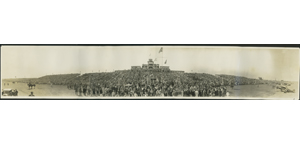 buddies in attendance, which might have included Jimmy Doolittle and Roscoe Turner. We don't really know that much about her time there, but we know for a fact that she was there thanks to a terrific photo that surfaced last year. The photo, now in the collection of Dr. Lou D'Elia and the Pancho Barnes Trust Estate, is one of those incredible panoramic images that was so popular in the early 1900's. It shows the entire grandstand which, incidentally, was situated at the west end of the Cleveland Airport. There are probably about 50,000 people in this photo, although of course it'd be a real trick to count them all.
 Scanning the faces with a magnifying glass, it is not hard to locate people who might be some of the famous attendees, including Roscoe, Graf Zeppelin pilot Dr. Hugo Eckner, event organizer Cliff Henderson, Thompson Trophy winner Doug Davis. One person who is plainly identifiable, and plainly visible, is Pancho. She's located towards the right-hand side of the middle of the photo. She's so prominent, in fact, that one has to wonder whether her being their is just a co-incidence! It wouldn't have been the first time that Pancho was at the right place at the right time...as author Gene Nora Jessen related to us, Pancho had a keen nose for publicity.
The trip to Cleveland would be an important one for Pancho. When Doug Davis won the Thompson, he would be flying a Travelair "Mystery Ship". The victory, and the publicity surrounding the aircraft, made a big impression on Pancho. She grabbed her check book, purchased an identical plane, and used it to break Amelia Earhart's women's air speed record (see 1-21-07 entry).
In a future Production Journal, I'll write a bit about an interesting historic artifact related to the 1929 race. A couple years ago I acquired a film of the event, made by the radio club Q.R.M. to commemorate their participation as race timers. An excerpt from the movie will appear in our documentary, and will represent the first time in roughly 80 years that it's been seen by the public.
 On the subject of the National Air Races and films, I'm excited to announce that a new documentary DVD has just been released! It's entitled The Story of the 1929-1949 National Air Races. This two hour film represents a labor of love by Joe Stamm, a retired oil-industry executive who flies a 1943 Stearman. Over a four-year period, Joe collected photographs and film footage documenting the glory days of the NAR. It's a fascinating story, one that has -- with the advent of the Red Bull Races and renewed interest in the Reno events -- growing relevancy.
The film begins with a prologue that summarizes air racing prior to 1928, and then launches into an encyclopedic description of each year's events. While watching it, you get a strong sense of the acceleration and advance of aviation technology that occurred in the early part of the 20th Century. The highly-souped up, experimental racing aircraft seem to change in form, speed and performance every year or two. One thing that remains constant, is the bravery and skill of the pilots who dared climb into the cockpits.
 There is some wonderful film footage included in the video, including rare color home movies and newsreels featuring famous people and planes, including the Gee Bees and Goodyear racers. You'll see clearly why the National Air Races were one of the biggest sporting events of their time, ranking right up there in terms of attendance with the Indianapolis 500 or the Kentucky Derby.
Sadly, one aspect of the races proved to be their undoing. Accidents were not infrequent. Organizers chose not to acknowledge the risks, probably because they viewed the events as a venue for experimentation. As a result, things could and did happen. The Gee Bee racers, for instance, were notoriously dangerous, and Russell Boardman was killed in the 1933 Thompson Race when his 'Bee went out of control. Throughout its history, however, no bystanders were killed at the NAR -- only pilots. But that changed in 1949, at Cleveland, when just two laps into the opening event of the NAR, Bill Odom's P-51 Mustang Beguine went out of control and crashed into a house. Odom was killed, along with a young mother and her child. The incident, and the coming of the Korean War, ended organized racing for some time to come. As the documentary makes clear however, the tragedy did have a positive result. When organized air racing began at Reno, safety of pilots and spectators became a priority, and it remains that way.
You can visit the website, and purchase the DVD, at this link.
If you're interested in reading more about the history of the National Air Races, a terrific website to visit is "The History of Air Racing and Record Breaking" here.
Last Updated: Wednesday, 12 August 2015 04:31 30 November 2007 Nick Spark Hits: 9361
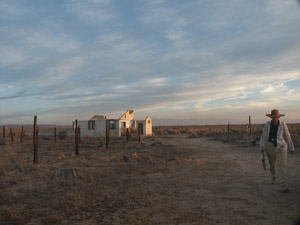 It's a little-known fact, but Pancho's Happy Bottom Riding Club still exists. At least, the outlines of it do. They are located near the Rogers Dry Lake, well inside the boundaries of Edwards Air Force Base. If you get the right permissions, and the folks at Edwards are not doing anything top-secret that day, and the nearby shooting range is not open for business, and you have an official escort, you can get out to see what remains of Pancho's spread. (Or, to make it slightly easier, get yourself invited to the somewhat-exclusive "Pancho Barnes Day" activities. That's a once-a-year celebration, that takes place near the ruins. But you might have to sweet-talk the General to get in!) Photo above: Documentary director Amanda Pope surveys the ruins of the HBRC. Behind her is what remains of Pancho's dairy. Photo below: the moon rises over the dairy. In the foreground is a rock chimney, a prominent feature of the ranch that appeared in many photos over the years -- see 11.12 blog entry!
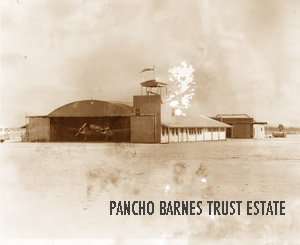
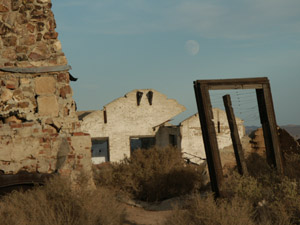 It's interesting that anything remains of Pancho's, actually! Because one of the reasons for the demise of the place, was that the Air Force acquired Pancho's property, and that of all her neighbors, to bulldoze it. The idea was to clear the area so that a new, seven-mile-long runway could be built for nuclear-powered bombers (see production journal entry for 3-3-07). Well, the "reactors in the sky" concept never panned out, and the runway was never built, so Pancho's got a reprieve. Sort of! The government had still bought the place, and there'd also been a fire (subject of a future journal entry) that destroyed quite a bit of the place. Pancho sold off her hangar (shown in the photo below), and the motel buildings, and they were trucked away and are still in use. What remained was scavenged by Pancho and a lot of other people who helped themselves to whatever they could find in the derelict ranch.
 Some of the things that remain to this day, are ruins of Pancho's dairy, the foundations of her hotel, her fountain -- which was built in the shape of the USAF logo -- and her unique circular swimming pool. Less obvious are the faint outlines of the runway that qualified the ranch as a "Fly-Inn" and Pancho's rodeo grounds.
Now, there is going to be one really amazing way to visit the Happy Bottom Riding Club, debuting in the near future. It comes to us courtesy of Randy Cain. Randy is an aviation buff, and a devotee of the computer program Microsoft Flight Simulator 2004. Yes, I know what you are thinking, why would anyone be a fan of three year old software? Well, turns out that the latest version of MFS doesn't support what Randy and other aficionados like himself do. Which is, create their own marvelous worlds, in the form of computer models, and fly through them via their mouse.
This past April, Randy and his friend Tom Gibson recreated Denver's now-defunct Stapleton Airport. Wow! It looks just as it looked in 1958. Click here to take a look
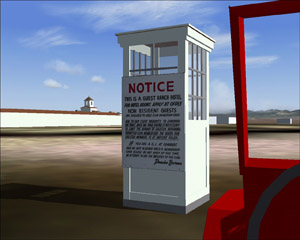 It turns out that after working all that time in snowy Denver, he thought it was time to take a trip to the sunny desert. So, he's been making a Happy Bottom Riding Club scenery package. Using vintage photos supplied by the Edwards Air Force Base History Office, and a bit of guesswork, he's put together quite an amazing representation of the ranch. It includes the hotel, the airport, swimming pool, and even the gate house (seen at right). He's omitted a few details, some by choice and some not. For instance, the main barn was excluded because it burned in the fire. Joshua Trees, which proliferate in the Mojave, were not properly modeled in MFS, so for now there are none.
 The release date for the scenery was originally October, but it had to be postponed due to unforeseen events. Randy tells me hopefully that it will be available in the coming months. When it is, we'll post a link. Meantime, if you're looking for a challenge, and want an interesting view of Pancho's today, you can always try to do a little scouting on Google Maps using the satellite view. here
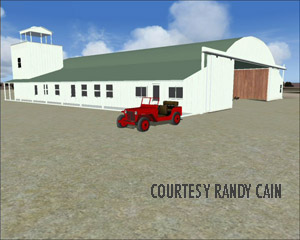
Photo: a jeep sits outside the hangar at Randy Cain's simulated HBRC airport. The actual hangar, which appeared in the noirish gangster movie "Johnny Stoolpigeon", was disassembled, relocated, and is still in use today.
11.21.07
New Article About Film in Airport Journal
A terrific article about the Pancho Barnes documentary is in November's issue of the the Airport Journal. You can read it here. Special thanks to author Clayton Moore (no relation to the Lone Ranger!) for taking the time to share our story, and Pancho's, with the world.
Last Updated: Wednesday, 12 August 2015 04:31 22 November 2007 Nick Spark Hits: 4320
Your tax-deductible donation can help make "The Legend of Pancho Barnes!" a reality.


 O-Sense