
Saturday, October 24, 2026

Last Updated: Wednesday, 12 August 2015 04:31 22 September 2007 Nick Spark Hits: 5868
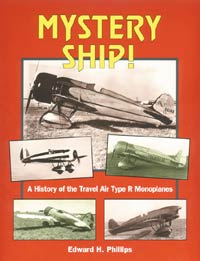 It's been some time since the topic of the "Mystery Ship", Pancho Barnes' famous airplane has been discussed in the Production Journal (see February 8th entry). For those of you whose memory is fuzzy...in 1929 Pancho saw pilot Doug Davis win the Thompson Trophy at the National Air Races in Cleveland. Davis was flying a new and radical monoplane, the Travelair Model R. The aircraft, which outperformed military planes entered in the races, humiliated the armed forces. It had been designed and built in secrecy. Thus, the moniker was born, "Mystery Ship."
Although only five ended up being built, the plane went on to set many records and became extremely famous. Many of the greats in aviation flew it including Jimmy Doolittle, Clarence Clark (the Travelair test pilot), Frank Tallman, Paul Mantz, Jimmy Haizlip and Frank Hawks. (Hawks' plane, the Texaco No. 13, is on display in the Museum of Science and Industry in Chicago).
In 1930, Pancho bought a Model R for around $13K, and in August of that year she shattered Amelia Earhart's air speed record, flying 196.19 miles per hour on a closed course at Van Nuys Airport.
The definitive book on the Model R is Ed Phillips' "Mystery Ship!", published in 1999 by Flying Books International. Phillips, who has an international reputation as an aviation historian, outdid himself with this book. It contains over 90 pages of photos, drawings and text, detailing the history of each Model R built, and chronicling an entire era in the process.
Earlier this year, Ed Phillips got in touch with us, offering his expertise and promising to answer any lingering questions about Pancho's plane not answered in his book. Actually, the book is so complete that there were no points seeming to need clarification! But, I did have one question for Ed � did he know of any motion picture footage of Pancho's plane, or any of the Mystery Ships?
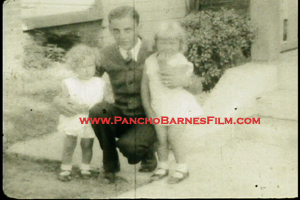 Turns out, Ed did have a videotape featuring historic Model R footage. The provenance of the tape, and the film on it, was quite amazing. Back in the 20's, two brothers worked for the Travel Air company as ferry pilots, delivering airplanes to clients across the United States. Their names were Newman and Truman Wadlow. Of course, they were friends with everyone at Travel Air, including Clarence Clark and company founder Walter Beech. They also got to meet many of the visiting pilots and customers -- a who's who of aviation in those days that might include aviatrix Louise Thaden on one Saturday and Army Air Force flier Jimmy Doolittle the next.
In addition to having a love of airplanes, Truman Wadlow loved movies, and bought a nice 16mm movie camera. Over the years he shot home films of his family, including his twin daughters Nancy and Betty, and an occasional trip. He also shot two cross-country ferry trips, a trip the National Air Races, and ... ta da ... footage of an open house at Travel Air, where the Mystery Ships were the center of attention.
Photo: Truman Wadlow poses with his nieces (frame pull from 16mm motion picture film)
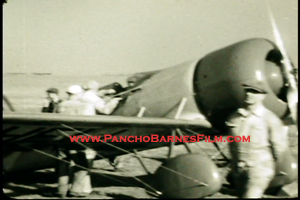
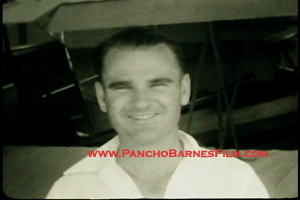 Truman Wadlow's footage provides a unique window into a lost era, showing the Travel Air company in full swing, just before the Great Depression. Some of the people who appear in the footage include a young Jimmy Doolittle (see photo), Frank Hawks, Walter Beech, and others. Several of Model Rs are seen in the film -- including "Texaco No. 13" and the "Shell Mystery Ship" -- along with other types of Travel Air planes including the Type 6B cabin monoplane.
The history of the "Shell Mystery Ship", as detailed in Phillip's book, gives some idea of the reason the aircraft is so strongly affiliated with the "Golden Age of Flight". It was flashy, fast, beautiful -- and dangerous to fly.
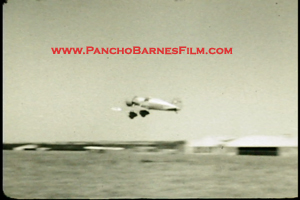
The Shell Mystery Ship was constructed over about six weeks at the Travel Air Factory in Wichita, and finished in February 1930. It was initially flown by James Haizlip and Jimmy Doolittle, who were both employed by Shell Oil for publicity purposes. Haizlip took the plane to the Detroit aircraft show, and participated in air shows in St. Louis and Columbia, South Carolina. It wasn't easy flying. On his flight back from Detroit, for instance, the plane's engine died during takeoff and he had to make an emergency landing. Later, a couple of the airplane's wing wires separated, placing the plane in a dangerous condition. Despite the problems, Haizlip continued to fly the craft. He placed second in the 1930 Chicago Air Races, flying an average speed of 199 miles per hour over the pylon course. He might have won, except for the fact that his engine began to burn oil. Later that same year his luck ran out entirely, as he crashed the colorful racer. The culprit was once again, engine failure during takeoff.
Photo: The Texaco Mystery Ship in flight, and on the ground at the Travel Air field, from 16mm home movie shot by Truman Wadlow
 Jimmy Doolittle ended up buying the wrecked plane from Shell, and rebuilt it into what he hoped would be an aircraft capable of achieving a speed close to 300 mph. The craft, registration NR482N, was equipped with a 560 hp Wasp Jr. engine. It was ready in June of 1931. During an initial test flight, Doolittle took the plane up to 250 mph. Observers on the ground noted, as Phillips recounts, that the plane suddenly appeared to have "struck a bunch of birds". In actuality, the right wing was disintegrating. As the left aileron departed, Doolittle put the ship into a climb, rolled it over, and jumped out. As he did so, he pulled the ripcord on his parachute. He was only about 300 feet off the ground, but miraculously he survived. His only injury was a minor abrasion, caused by his parachute cords briefly catching his neck. The plane was totally destroyed.
For Doolittle, it was his second close call in as many years. He had "hit the silk" while escaping from a Curtiss Hawk at the 1929 National Air Races, after a wing failed during acrobatic maneuvers. This time, however, Doolittle did not blame his plane, but himself. By introducing a new wing fairing design, he acknowledged after the crash, he inadvertently weakened the wing structure while encouraging flutter.
Truman Wadlow's home movies don't show Jimmy Doolittle's crash, nor do they feature any footage of Pancho Barnes' Model R. But, they are important to our project. Without question, some of this rare, never-before-seen material will be included in the film, along with some other, extremely precious footage we've managed to locate of Pancho's plane.
A special thanks is owed to Truman Wadlow's family, in particular his daughter Nancy, for making the film available to us. Thanks as well to Edward H. Phillips for documenting the "History of the Mystery" and for generously assisting us with the project.
Last Updated: Wednesday, 12 August 2015 04:31 16 September 2007 Nick Spark Hits: 6063
 The 1929 Women's Transcontinental Air Race — better known as the 'Powder Puff Derby' — attracted some of the best aviatrixes of the era, including Amelia Earhart, Louise Thaden, Bobbi Trout and Pancho Barnes. Another participant, Marvel Crosson, isn't as well known today, but certainly seemed poised for the limelight. Her name was Marvel Crosson, and she was good friends with Pancho. They were the same age, 28, and both shared a passion for aviation and had good-natured personalities. Shortly after meeting, the two resolved to be 'buddies' during the Derby, and they were roommates on the first night of the race.
Born in Indiana, Crosson had moved with her family to San Diego in the early 1920's. As she told a reporter, she was inspired to fly when she first "...saw that first airplane high in the sky above my little ranch home in the San Bernardino Mountains." At her urging, and with some of her money, her brother Joe bought a surplus U.S. Army biplane. She took to the sky like a natural, and said that flying "...has been so good to me. It has given me splendid 'breaks' every so often."
 Marvel went on to do something spectacular. In 1927, she accompanied Joe to Alaska Territory, where he had sought work as a bush pilot. In a short time, she became the first woman to receive an Alaska pilot's license. At that time, airplanes were fairly new to Alaska, and their arrival was not welcome by mushers, whose dog sleds moved goods around the state. Some local businesses even put up signs on their doors that read, "No dogs nor pilots allowed". The Crossons did their best to prove that aviation had its place in the wilderness, and in 1928 they flew cross-country together. Later that same year, Marvel returned to California after her brother decided to embark with Hubert Wilkins' Polar Expedition. (He soon became the first pilot to fly over the Southern Polar Continent.)
Once back in San Diego, Marvel Crosson decided to try to set a new women's altitude record, held by Louise Thaden. She managed to do it, soaring to 23,996 feet. "The breaks were all in my favor," she said of the flight. "Can't you see how good aviation has been to me? Surely, you understand why I fly, don't you?" When asked by another reporter if she'd had enough of danger, if she should give up flying, she declared, "I don't think I'll ever give up flying. It means everything to me. Oh, yes, I used to play tennis and go to dances, but they're not in it with flying for pleasure. And besides, I'm combining fun and work."
 Competing in the Powder Puff Derby would be another big feather in Marvel Crosson's hat. Winning it might have even brought the kind of notoriety reserved for Amelia Earhart. "Why do I fly?" Crosson replied, when a reporter asked her that question, on the eve of the Derby. "Because it is my profession, my way of earning a living — and because I love it."
But right from the start, Crosson and other race participants ran into trouble. Accusations and suspicions haunted the event, as several of the racers complained their aircraft had been tampered with. Ruth Elder discovered oil in her gas tank. Claire Fahy insisted someone had damaged one of her plane's wing wires. Pancho recalled, in a speech given at the EAA, that Marvel,"...was very, very worried because she said something was wrong with her airplane. She thought it was sabotage. I said, "Oh, that is ridiculous, who would do anything like that?"
 On August 19, 1929, Marvel Crosson's plane failed to reach Phoenix. Initially, that was not cause for any great alarm, but as time passed the situation began to look grim. Finally, on the 20th, the report came from Yuma. Crosson's plane had been found near Wellton, where it had crashed. According to one report, a rancher had seen it wobble in the air, and then spin into a grove of cottonwood trees. Crosson was killed on impact.
Despite the tragedy, the race continued. As Gene Nora Jessen recounts in her book, "The Powder Puff Derby of 1929", the other participants felt that Marvel would want them to continue despite the tragedy. After all, aviation had been good to her.
The cause of Marvel Crosson's death was never determined. While some of her friends felt her plane must have been tampered with, others were not so sure. Louise Thaden, who went on to win the race in the same type of Travelair that Crosson flew, had previously experienced an in-flight bout of carbon monoxide poisoning. It was caused by fumes from her plane's engine, which entered the cockpit due to a badly-designed exhaust system. So perhaps Crosson had passed out, after breathing in carbon monoxide? It's impossible to know, but one fact is indisputable: Travelair modified their planes' exhaust system in the wake of Crosson's death.
Postscript: Regarding Marvel's brother, Joe Crosson went on to have a storied career as a pilot. He made the first-ever airplane landing on Mt. McKinley, flew serum to the Alaska coast to prevent a plague, helped Wiley Post complete his flight around the world, and helped retrieve Post's and Will Rogers' bodies after their fatal crash in 1935. Joe Crosson passed away in 1949 in Seattle, Washington.
Last Updated: Wednesday, 12 August 2015 04:31 11 September 2007 Nick Spark Hits: 4735
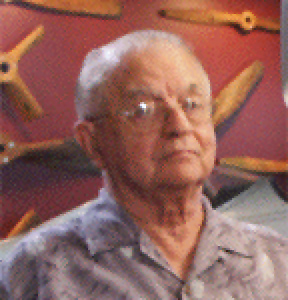 In 1946, Bob Cardenas was sent to Muroc AFB to work on the XB-45, a top secret jet bomber which joined the Air Force in 1950. He vividly remembers the day he first met Pancho Barnes. Frank 'Pete' Everest, a fellow test pilot working on the X-1 program, invited Bob to join him at the Happy Bottom Riding Club. First, however, he had to undergo a rite of passage -- an audience with Pancho.
"It was a ritual that you had to go through," he recalled in our recent interview. "You went to the house and knock on the door. The first view I had of Pancho, she was in a pair of panties and a sweatshirt and her hair all over the place. And she was looking at your face real well to see what kind of a shock treatment you got. I forgot what I said. I said some stupid thing like, 'nice sweatshirt' or something like that. That was my introduction," Cardenas continued," and apparently I passed because from then on, I could walk over there any time I wanted to."
Cardenas paints a vivid illustration of the rough-and-tumble bar and hotel that was Pancho's "Fly-Inn". One thing he vividly remembers (but which we've never seen a photo of) is a work of art which may have been destroyed in the fire that later ravaged the ranch. "There was a painting behind the bar," he explains, "of [Pancho] in boots and britches and a leather jacket. And she had one arm around Second Lt. Tooey Spatts, and the other arm around Second Lt. Hap Arnold. That impressed the hell out of me being a young guy, who the hell she really was, a pilot. And a damn good one."
 For Cardenas, Pancho's bar was "a place you could relax, I mean really relax." It was a wonderful place, and sorely needed, because of what they went through during the day. "Some of your test flights were a little hairy," he remembers. "And part of the breaking down and settling after the day's flying was being with someone that you could talk to, that understood what you were talking about. And she was a good listener and you could use any kind of language you wanted to!" Bob laughs and adds a little test pilot philosophy into the mix. "There wasn't fear," he explains. "I want to make it clear that, you could be afraid but you didn't have fear. Fear is actually your best buddy, it's your best friend. It keeps you from making stupid mistakes."
As for Pancho's famous hostesses, Cardenas dismisses any notion that they were anything but social entertainers. "Yes, she had some young ladies that would dance with you," he says. "They'd play the piano and they served you the food. And you could talk about anything you wanted to talk about. I remember the thing [Pancho] told me one time. She said, 'I have nothing against love, but not on this place. You want to shack up with her, you take her to Hollywood but not in here, okay?'" He smiles and then adds, "Of course, one reason that I didn't go to Hollywood with any of the gals, was I had my sweetheart Gladys back in Dayton, Ohio."
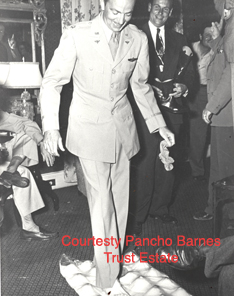
That's not to say Bob Cardenas didn't enjoy some of the spectacular events at the Happy Bottom. One thing he remembers vividly is a gimmick Pancho worked up. At one point, she told her pilot guests that breaking the sound barrier entitled them to a free steak dinner. Soon the feat became commonplace, and Pancho found that she was giving away an awful lot of steaks! So, she developed a new gimmick, obtaining an uncut rubber mat of fake women's breasts or 'falsies'. Whenever a pilot set a record, broke the sound barrier, or "did something stupid", he'd have to walk across the mat. This "booby prize", Cardenas explains, was pure Pancho. "Yeah, well, Pancho was always dreaming up of ways to, you know, get at you," he says. "Shock treatment, you might say."
 Postscript
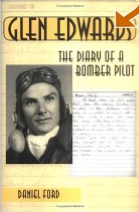
Pancho Barnes often told friends that Glen Edwards ate dinner in her restaurant the day before he was killed. In the book Glen Edwards: Diary of a Bomber Pilot, author Daniel Ford suggests that Pancho's memory may have been incorrect. Whatever the case, Edwards did visit the rancho, and Pancho was clearly saddened by his death.
One thing that did clearly rub Pancho the wrong way, was the Air Force's decision to change the name of Muroc to 'Edwards'. Pancho complained in a letter to Air Force Col. Schuler, that the name-changing was "illegal" and "harmed my business." Pancho had another reason, other than economics, to be aggravated. After all, many, many men were killed in the early years at Muroc/Edwards -- historian Ray Puffer puts the figure above 340 -- and Pancho doubtlessly knew quite a few of them. Plus, it was Hap Arnold and men like Al Boyd who really put the base on the map. So while Glen Edwards may have deserved the honor, Pancho hinted to friends that she'd wished ... it had been named after someone else.
Last Updated: Wednesday, 12 August 2015 04:31 03 September 2007 Nick Spark Hits: 4440
 A tremendous visionary, aviation engineer Jack Northrop's designs consistently pushed the envelope. In the late 1920's, he built an aircraft for Avion Co. that had a pusher engine and a radically diminutive tail structure -- so minimal that observers called the plane a "flying wing". Problems with the design kept it from production and led to the dissolution of Avion, but Northrop didn't give up. In 1939, he set up a new company, Northrop Aircraft, to build a more advanced design, the N-1.
In 1942 Northrop built the N-9M, a 60-foot tailless "flying wing" equipped with two propeller-driven, air-cooled pusher engines. It served as proof of concept for a gigantic, 172-foot wide bomber designated XB-35. "It was a beautiful concept," remembers Bob Cardenas, who first learned of the plane around 1946. "In a regular airplane you have a wing. You attach a fuselage. A fuselage is where you're carrying all the weight. So the wing's spar, that's holding that fuselage, has to be a very large, and very heavy structure. When you remove the fuselage and the tail, the total wing surface is all lift. You can go anywhere in the world in that airplane."
What a different 20 years makes! Above photo: The Northrop-designed Avion in flight, with pusher propeller, circa 1929. Photo below: The gigantic YB-49 takes off from the Northrop plant, circa 1948.
 The range of the XB-35 intrigued military planners, who imagined that a prolonged war with Germany or Japan might require extreme long-range bombers. At one point in 1943, over 200 of the planes were on order; but problems encountered during the N-9M test program, including a fatal accident, eventually led to cancellation of the contract. Nevertheless an experimental program continued, and an XB-35 eventually flew in June of '46. By then, the Air Force had been persuaded to extend a contract for a jet-powered version of the plane, the YB-49. For Bob Cardenas, being assigned as chief test pilot on the YB-49 program initially seemed like a dream come true. The airplane itself represented a terrific leap forward in aviation technology. "As a test pilot of so-called 'X planes'," Cardenas remembers, "I probably flew about a dozen -- not on their first flights mind you. The one that of course caused me the most grief was the YB-49. I started first with the little N-9M propeller job. I learned that it had some different characteristics. In a normal airplane, you shove the right rudder, and you turn to the right. In a flying wing, you shove in the right rudder. and you're turning about the tip. So you have to coordinate the ailerons, elevons, with your rudder to get the proper turn. When you catch on, it's not much different."
 What did give Cardenas pause, and what made him begin to believe the YB-49 might be an aircraft ahead of its time, was the plane's instability. "One of the first things you have to do (in a flight test program)," he explains, "is find out at what speeds it stalls. When an airplane stalls normally, the wing ceases giving you lift, and it falls off. You get a little turbulence. I knew (in the YB-49) I wouldn't get too much, cause the airplane had no tail. So, I was waiting for the slight buffet. But instead of that it gave a lurch and it went over backwards. And it started tumbling backwards." As the huge plane flipped end over end, Cardenas and his co-pilot Danny Forbes had their hands pinned to the ceiling by tremendous G-forces. The plane was completely out of control, and headed for the ground.
Fortunately for the test pilots, the YB-49 wasn't an ordinary airplane. For one thing, there were throttles located above the pilot, near the cockpit ceiling. "Although my rear end was off the seat," Cardenas recalls, "I was able to reach the left throttle and apply 100 percent power for engines on the left side." That did the trick: once the airplane had power on the left side, the airplane cartwheeled into a recoverable spin.
"When I landed from that flight," Bob Cardenas remembers, "I wrote a one page report: the aircraft is never to be intentionally stalled."
Last Updated: Wednesday, 12 August 2015 04:31 03 September 2007 Nick Spark Hits: 4653
 Bob Cardenas' one page report (see previous Production Journal entry) about the YB-49's stall problem should have sealed the YB-49�s fate, but Northrop and the Pentagon felt the issue could be fixed. The program continued. In 1949, at the behest of Northrop and President Truman, Cardenas was ordered to fly the plane from Muroc to Andrews AFB. "We parked it on a ramp by the B-36 (Peacekeeper), and Truman came into the cockpit," Cardenas says. "He looked around. He was a pretty crusty old guy. He said, 'Looks pretty f---ing good to me. I think I'm going to buy some of these.'"
Truman ordered Cardenas and his co-pilot to fly down Pennsylvania Avenue, so that Congress could see what they were going to be buying. "I was sure that they wouldn't make me do it," Cardenas recalls. "But (Cmdr. Al) Boyd got ahold of me and he said, 'Bob, you've got to do it. Slow it down a little bit.' So, I flew down Pennsylvania Avenue. And, I did slow it down, to about 300 miles an hour. But, I had never really realized how heavily forested the city of Washington is. I would lose it amongst the trees. Suddenly, I looked up and the Capitol dome was dead ahead! I had to pull up to go over it."
Photo: Snapped by a tourist, this is the one and only known photo of the YB-49 flying over the Capitol building. (That is, unless you see the 1953 movie "War of the Worlds" which features the bomber in combat against UFOs in the skies above Washington!)
 On the way back from Washington, over the Rocky Mountains, a fire broke out in the number six engine, and then in number three. The nearest airport that could accommodate the plane was in Winslow, Arizona -- and just barely. The runway was 50 feet wide, and the YB-49 had a 42-foot wide landing gear arrangement. By the time he made his approach, only two of the massive bomber�s engines were functioning. Fortunately, he made a solid landing, and the fires were extinguished. (Turning the plane around so it could take off, after it was repaired, took quite a bit of work!)
The Winslow flight soured Cardenas on the YB-49 program, and convinced him that the time had come to leave and finish his aeronautical engineering degree at USC. His hand-picked replacement was a friend, Glen Edwards. "Glen was a combat pilot in North Africa," says Cardenas. "He was extremely intelligent. He helped Dr. Perkins at Princeton write the book on stability and control. He was a good test pilot."
But Glen Edwards' skills could not save him from disaster: on June 5, 1948, the Flying Wing crashed killing Edwards, Danny Forbes, and three other crewmen. "On the way down to San Diego," Cardenas remembers, his voice slightly shaky. "I heard on the radio it crashed. I did a 180, and went back." Col. Al Boyd assigned Cardenas to the accident investigation team. It didn't take long for Cardenas to realize that, at the time of the incident, Edwards was attempting a stall maneuver -- the very kind of maneuver Cardenas'd warned against.
"Glen Edwards knew that," says Cardenas, "I talked with him about it." Why had Edwards done it anyway? It's pure speculation, of course, but it's clear that the plane's instability issues made it susceptible to cancellation. Northrop's engineers had probably persuaded Edwards that, with proper testing, he could find a way around the aircraft's handling problems.
 Five men were dead, and one of the two YB-49 prototypes was destroyed. A long investigation followed, and a Congressional hearing. In 1950, the entire program was canceled.
Cardenas paid a heavy price for his criticism of the failed aircraft, but he felt it was his duty as an Air Force officer to tell the facts as he saw them. While many in the aviation community point to a conspiracy surrounding the cancellation of the YB-49, and the advent of the B-2 Stealth bomber as proof of the concept, Cardenas is quick to point out that modern technology, such as computer stabilization, keep the B-2 airborne. Such things simply did not exist in the world of the 1950's.
In 1949, Muroc Air Force Base was renamed in honor of Glen Edwards. As part of our documentary interviews, Amanda Pope asked Bob Cardenas to share some memories of the man. "He could really cook," replied Cardenas, with a smile on his face. "As a dancer he could have matched Fred Astaire -- all the women wanted to dance with Glen. I sorely miss him. I think it's a good choice that they named the base after him. Because he was a consummate test pilot."
Photo: Bob Cardenas (left) with Glen Edwards, shortly before he was tragically killed in the crash of the YB-49.
Coming up next in the production journal: Bob Cardenas remembers Pancho Barnes, and Pancho's own memories of Glen Edwards.
Last Updated: Wednesday, 12 August 2015 04:31 28 August 2007 Nick Spark Hits: 4100
 Brig. Gen. Robert "Bob" Cardenas flew B-24 Liberators on combat missions over Germany during WWII, worked as a test pilot for the Air Force during the Cold War, flew F-105s over Northern Vietnam, and was so important to the shaping of the Special Forces that he was elected to the Air Commando Hall of Fame. If he wore a military uniform — he doesn't nowadays because he is blissfully retired and a Hawaiian shirt is more his style — the chest would be obscured by various medals, from the Purple Heart to the Air Medal, Distinguished Flying Cross, Distinguished Service Medal, and more. All of these honors, for a guy born in Yucatan, Mexico, who didn't come to the United States until he was five, and who never dreamed he'd go to college, much less succeed like he did. He's the embodiment of what some would call the American Dream.
Photo: Bob Cardenas interviewed by Amanda Pope at the Allen Airways Flying Museum
 Bob Cardenas' affiliation with flight test began right after WWII, when as part of a special assessment effort he flew the captured German Me-262 jet fighter and Arado 234 bomber. The place for all this flying was a remote facility located near the Rogers Dry Lake, called Muroc AFB. In 1947, Cardenas — by now well known for his skills flying a multi-engine bomber — was entrusted with the task of piloting the B-29 mothership for the X-1 supersonic rocket plane tests. His co-pilot was Jackie Ridley, the brilliant young engineer who receives a great deal of credit for his insights into the problems of compressibility.
Taking off with the X-1 strapped under the belly of a B-29 bomber might sound a bit hairy — after all the rocket plane was full of volatile fuel — but Cardenas recalled in our interview that take-offs were the least of his worries. "On takeoff," he recalled, "I would have 10 inches between the belly of the X1 and the concrete and it’s loaded with 600 gallons of liquid oxygen. I can’t raise the nose wheel too much or I’ll scrape it, but that was not a problem cause I had a long runway. My one nightmare," he continued, " was, what would happen if I said drop and the X-1 would not drop? I would have to land with that thing hanging on."
Photo: The X-1 team including l-r Ed Swindell (flight engineer), Bob Hoover (back-up and chase pilot), Chuck Yeager (pilot) and far right Jackie Ridley (B-29 co-pilot and project engineer).
 A lot of worst case things that happen during a flight test program are predictable — Murphy's Law was in fact coined at Edwards AFB — and as it happened Cardenas' worst nightmare did come true. "This one particular flight," he remembers, "I said 'drop', and Jackie hit the lever — and it didn’t drop."
There followed some nervous minutes. Chuck Yeager, who was already strapped into the X-1 and ready to fly, decided to stay in position, in case it fell free. Meanwhile he offloaded fuel from the ship. Cardenas took the B-29 down to about 5000 feet. At that point Yeager climbed out of the rocket ship and back into the B-29. Now, Ridley and Cardenas made their final approach. Either they'd make a good landing, or they wouldn't have to pay for cremation much less burial!
"I went in and I made the landing," Cardenas remembers. "And it was probably the best landing I’ve ever made in any airplane. I did not even hear the rubber screech - the plane kind of rolled on in. So we made it."
After the sound barrier was broken, Cardenas flew the XB-46 jet bomber and a host of other experimental aircraft. A real challenge lay ahead, however, one that would not only change Cardenas' life, but the history of aviation, and Muroc itself. Stay tuned ... for the next journal.
Photo (left above): The underside of the B-29 shows how tricky a landing with the X-1 could be!
Your tax-deductible donation can help make "The Legend of Pancho Barnes!" a reality.


 O-Sense