
Saturday, October 24, 2026

Last Updated: Wednesday, 12 August 2015 04:31 20 August 2007 Nick Spark Hits: 5458
 Pancho Barnes may not have been involved in Amelia Earhart's flight around the world in 1937 — by then Pancho's own flying days were behind her — but she was friends with the aviatrix, her navigator Fred Noonan, and her consultant, Paul Mantz. In the late 20's and 30's, Earhart maintained a house in North Hollywood, and Pancho remembered visiting it frequently. According to Pancho, Amelia Earhart's mother — who incidentally claimed to be the first woman ever to scale Pike's Peak — used to babysit Pancho's son Billy, so that she and Amelia could socialize.
Photo: Barnes, Earhart, and Gladys O'Donnell
Pancho had her own take on Amelia Earhart's disappearance, and while much of it is of the "second hand" variety, it's also somewhat intriguing. According to Pancho, Paul Mantz confided in her that he did not believe Earhart was as disciplined a pilot as she should have been. "Paul found out that she couldn’t use her fuel analyzer very well," Pancho recounted. "She was indifferent to it. She didn’t try hard enough. She was a little bit lazy about it." If Earhart had calculated her fuel mixture incorrectly, she would have harmed her plane's performance and endurance. " If you have a proper mixture control..." explained Pancho, " if you go up on say 10,000 feet, you’d get a better performance out of it and burn less gas, if you could rarify the carburetor to where it wasn’t as heavy a mixture. So she didn’t know how to do this. She didn’t have enough on the ball, to keep her doing it right. Now that is what killed her, probably. Cause she ran out of gas 200 miles before she got to Howland Island."
 Another aspect of the disappearance that is often pointed to is Earhart's navigator, Fred Noonan, who detractors labeled as an alcoholic. Pancho, however, held Noonan in high regard. "She had the best navigator in the whole — that they could find anywhere," Pancho explained. "Probably the finest navigator in the world. And [Noonan] was also an instructor." In Pancho's mind, two factors were really responsible for Earhart's loss. One was her failure to mix her fuel properly. In the trackless Pacific, misjudging fuel use can be and perhaps was fatal.
Still, Earhart and Noonan might have been able to ditch, and could have been picked up, if it hadn't of been for another problem. That is the other factor Pancho pointed to — the lack of radio communication between AE and Coast Guard personnel during the ill-fated trip. Earhart simply did not respond to the Coast Guard messages. According to Pancho, Earhart's ventral or belly antenna had been severed during her take-off from Lae. (See the TIGHAR website mentioned in Part 1 about this).
Photo: Earhart and Fred Noonan on the World Flight, 1937.
 In any case, while most of her discussion about Earhart falls into the realm of conjecture, Pancho did share one interesting tidbit that may give some insight into AE, and may be "fresh" information. It's well known that, in those days, publicity counted. According to Pancho, few understood this the way Earhart and Putnam did. Had she made it back to Los Angeles, Pancho believed, it would have been without her navigator. According to Pancho, "She was going to leave Noonan [in Hawaii]. She told me herself she wanted to arrive alone in the airplane. She was going to kick Noonan off, because she’d made that flight once in the airplane and it was pretty easy to hit the mainland."
At the time Pancho spoke about Earhart, new revelations had just come to light in the form of a book, "Amelia Earhart Lives". In it, a woman named Irene Bolam was purported to be AE. The book, which has now been completely debunked, made headlines. Another book, "The Search for Amelia Earhart", made the New York Times best seller list. Pancho was dismissive of both. "It's all bullsh*t," she explained. "It’s all just to make money. It’s a lot of - it’s just all dreams."
Photo: Statue of Amelia Earhart, located in North Hollywood, near where Earhart lived and worked. Courtesy of the great J. Ron Dickson, whose website has an aviation history of the San Fernando Valley. Click here
Last Updated: Wednesday, 12 August 2015 04:31 10 August 2007 Nick Spark Hits: 6443
 If one individual embodies the spirit of the female aviators of the twenties, that person would be Amelia Earhart. Often called simply by her initials "AE" — or by the moniker "the Lady Lindy" — Earhart's achievements in the air were without parallel. Her initial brush with fame came about in 1928 as a result of her becoming the first woman to cross the Atlantic by air. She did not make the crossing as a pilot, however, but as a passenger. That might have exposed her to ridicule from various circles, but Earhart backed herself up with real achievements. She flew in the Powder Puff Derby of 1929, set air speed and altitude records, and in 1932 she crossed the Atlantic solo — the first person to do so after Lindbergh. For that feat she received the Distinguished Flying Cross.
Pancho Barnes met Amelia Earhart at the Powder Puff Derby, and while the two probably could not be characterized as close friends, they did get together socially. Pancho recounted Earhart calling her and visiting with her on a number of occasions. In July of 1932, when AE visited Los Angeles (on the occasion of completing her Atlantic solo), Pancho organized a celebratory banquet for her. Five years later almost to the day, Amelia would be missing. Her disappearance remains one of the great mysteries of 20th Century aviation history.
Photo: Pancho Barnes, Elizabeth McQueen, and AE at Clover Field in Santa Monica, 1929. Behind them is AE's Lockheed Vega.
In the 1970s, Pancho made a few speeches, and granted several interviews about her own life and career. Inevitably, the subject of Amelia Earhart came up. Pancho spoke forthrightly about her rival, noting that in her opinion Earhart initially was "a lousy pilot" who became an aviatrix only because her husband George Putnam "kept pushing her through." She recounted that, at the time Earhart flew the Atlantic in 1928, she really didn't know how to fly. "Frank Tomick, who was one of our motion picture pilots," Pancho told an interviewer, "taught her to fly after she made that flight."
In Pancho's opinion, Amelia Earhart and the legend surrounding her were the creation of Earhart's husband, George Putnam. "She was a publicity figure for him," said Pancho. "That’s what he hired her for."
Nevertheless, Pancho admired AE's accomplishments and her personality. She repeatedly said, though, that in her estimation Earhart had one flaw — she thought she was unbreakable. "She had to have this faith," Pancho noted. "She thought nothing could ever happen to her. She really thought that. And then eventually, you know, she did everything wrong about this flight around the world."
 In March of 1937, Amelia Earhart set off to on the first leg of her world flight, travelling from Oakland to Honolulu in her Lockheed Electra. During departure from Luke Field, the Electra ground-looped, and the attempt was put on hold. "So she tried this going around the world once and she got as far as Honolulu," Pancho remembered, "and tried to take off and cracked up on the take-off. And once she came back I told her, I said, 'Why don’t you give it up Amelia, just quit?' No, she was going to be the first woman to fly around the world. Anyway, Paul Mantz rebuilt the plane. [Earhart and navigator Fred Noonan] started flying around the world in the other direction." They made it about two thirds of the way, to Lae in the Pacific, before the Electra vanished.
 Pancho told her own version of the events of July 2, 1937, when Earhart and Noonan disappeared. It's hard to know if it's an accurate telling of events — but of course anyone who has done any reading about the disappearance will tell you it's nearly impossible to sort fact from fiction! (A good website to read about the continuing controversy and on-going efforts to solve the mystery is The Earhart Project)
According to Pancho, her friends in the Army Air Force were monitoring Amelia Earhart's radio transmissions on that fateful day, and keeping Pancho abreast of her whereabouts. "She was on the radio," Pancho told an interviewer. "The Navy didn’t pick her up, but the [Army] Air Force, who were just tracking her from an interest point — in other words it was none of their business but they were just curious and interested and enjoyed doing it — they were tracking her. And they picked her up. And she radioed that she was running out of gas 200 miles short of Howland Island and she was gonna have to ditch the ship. And they phoned me. She actually crashed about 7 o’clock in the morning. So they phoned me about 8 or 9 o’clock and told me she had crashed. And I said, 'Gee is there anybody out there looking for her?' They said, 'Don’t worry about it Pancho. She had the radio on when she crashed. We heard her crash. We heard her scream, and I don’t think — they said — they won’t find her. Now, I knew this a couple of hours after she crashed. And nobody knew it yet. The Navy didn’t know it. The news didn’t know it. Nobody knew it. But I knew it."
Pancho had her own opinion about what went wrong, which I'll get to, in a future Production Journal. Stay tuned!
Last Updated: Wednesday, 12 August 2015 04:31 09 August 2007 Nick Spark Hits: 5277
 Sadly, the nation's longest-serving television anchor, KTLA's Hal Fishman, passed away this week. Although Hal was known primarily as a television persona, I was a bit surprised that few of the tributes given to him have mentioned his passion for aviation. Hal was a truly impressive fellow, apparently as cool and calm in the air as he was in front of the television cameras, and an accomplished pilot. In 1969, Hal shared the storied Fédération Aéronautique Internationale's Louis Blériot Medal with his friend Barry Schiff. The two went on to write a number of books together, including the aviation thriller "Flight 902 is Down!". Fishman held thirteen world records for speed and altitude, most recently (I think) hitting the mark of 943.97 miles per hour with pilot and friend Clay Lacy in a Gulfstream G-II. You may not have heard about it, of course, because I don't think Hal ever mentioned it in his newscast!
Photo (above): Hal Fishman with his good friend and co-author, Barry Schiff, courtesy of Barry Schiff. (below) Fishman at an aviation event, in front of a B-17, also courtesy of Barry Schiff. See www.barryschiff.com for more.
 Aside from holding all those records, Hal Fishman was a promoter of aviation here in the Southland. He'd occasionally bring a TV camera aboard his plane, and show viewers at home his unique perspective of Los Angeles. (At one point, to dramatize the need for increased aviation security and scrutiny of applicants for licenses, he went into the air to point out the vulnerability of certain landmarks to airborne attack.) He was also an ever-present figure at local air shows and events, and appeared in the film "One Six Right" celebrating the Van Nuys Airport (see earlier production journal). I spoke to him on the phone about "Pancho" at one point, and he provided a lot of encouragement, and a number of leads. Then, a few months later, I met him at a ceremony at the Santa Monica Airport to mark the re-birth of the Museum of Flying. He spent a few moments with me, encouraging progress with the project and saying he hoped to be there for the premiere. He was gracious, and gregarious when it came to talking about Los Angeles aviation history. He was certainly a part of it.
Incidentally, a nice write-up about Fishman's passion for aviation and automobiles appears on Steve Parker's blog, The Car Nut
Last Updated: Wednesday, 12 August 2015 04:31 06 August 2007 Nick Spark Hits: 5245
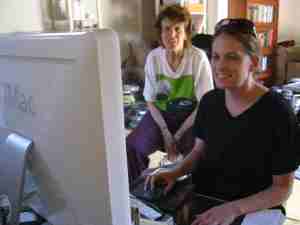 Shooting nearly twenty interviews for the "Pancho" documentary took many months. Gathering the photographs, documents, motion picture film footage, and other materials for it took years. And, I don't even want to begin telling you how long it took to raise the money to make the film — a long time — and that's an on-going process. So, it's with a sense of relief that we've finally reached the point where we can begin editing the film. It's more than the "end of the beginning" — and the real "beginning of the end"!
Photo: "Mo" working with director Amanda Pope
Our editor, by the way, is the talented Monique Zavistovksi, or "Mo" as she likes to be called. Her enthusiasm and insight into Pancho have brought fresh energy to the project, which is important for director Amanda Pope and I. After all, when you live with a project like this one for a number of years, it's easy to lose your perspective. Thankfully, Monique had never heard of Pancho Barnes before she joined our team. With no preconceptions or knowledge of our subject or material, she was able to assess what we have gathered together on a more-or-less impartial basis. That's critical on a project like this one. While Amanda and I have certain ideas about Pancho's life, our footage may reflect a different story on some levels. So, it's important to discuss the difference between what we've envisioned, and what Monique sees in our footage.
Someone, I think it was Martin Scorcese, once said that the editing process is a bit like a long conversation. In the world of the documentary film, that is especially true. Our conversation began with a script, which I spent a couple of months writing. The script was based on our interviews, documents we'd uncovered (including Pancho's incomplete autobiography, interviews conducted with her prior to her death, personal letters and even her FBI file), and other materials. Yet a script can only get you so far: the first assembly Monique made using the script was over two hours long — twice what we're aiming for. Still, it provided a road map for our editorial journey, reflecting the themes, story points, and ideas I felt were important.
We're still at an early stage in our process. Right now, Mo is taking on segments of the film and chopping away at them. Sometimes she's auditioning new portions of our interviews, or adding voice-over or photographs, and sometimes she's taking them away. It's a long and involved process, and in the course of several hours many different versions of the film come into being. After a few days of solid effort, Mo shows her progress to Amanda Pope and I, and we critique it and roundtable it. Think — conversation. Then, it's back to more cutting.
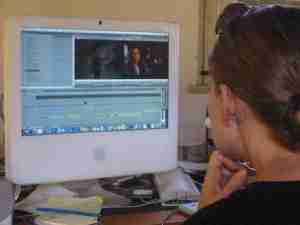
Making even an assembly cut is a process that used to take months. Fortunately, nowadays we have wonderful digital tools that allow random access to our footage. For those of you who are curious, we're using Final Cut on an Intel-based Macintosh iMac. For a project like this one, which involves many different types of media (photos, video footage, film footage, graphics and special effects), and is relatively low-budget, this is a natural choice. Final Cut allows us to work efficiently and manage all of our materials without being overwhelmed by them. . . which certain can be the case on a project like this one.
 Incidentally, Mo just recently cut another film on Final Cut, one that you will hopefully see soon in theatres or on the small screen. Circus Rosaire was made by our mutual friends, the husband and wife team of Robyn Bliley and Chad Wilson. It's a touching documentary about a family-run circus, and it just won the coveted Audience Award at the Sarasota Film Festival.
If you visit the Circus Rosaire website, you can find a brief bio of Monique. Or just click here if you are curious.
Last Updated: Wednesday, 12 August 2015 04:31 24 July 2007 Nick Spark Hits: 6747
 Test pilot, stunt flier, hellraising owner of the Happy Bottom Riding Club guest ranch — Florence "Pancho" Barnes was all these things. She was also, truth be known, a minister's wife! Her first husband (she had four) was the Reverend Calvin Rankin Barnes, whose father was the rector of a large church in San Diego. A pious man who earned a reputation as a church leader during a long and storied career, Rankin Barnes was not a very good match for young Florence. Theirs was not a marriage for the sake of love or romance, but an arrangement made by Florence's parents, Thad Lowe and Florence Dobbins Lowe. Her parents whistfully hoped that marriage would put the brakes on Florence's predeliction for creating trouble. It did, but not for long.
Photo: The January 5, 1921 wedding of Florence Lowe to the Rev. C. Rankin Barnes, at St. James Church in South Pasadena.
 "I had married a clergyman and that was to be my life," Pancho wrote in her unpublished autobiography. "I taught Sunday school. I had a class of boys about nine years old. I bribed them with jackknives to learn the catechism." Her life was far busier in many ways than that of her mother, who had a staff of servants. "I entertained at dinner, I cooked meals, I planned things in the parish house," she noted. "I embroidered beautiful embroidery for the veil, that is the veil for the chalice. I worked with various color satins, starting off with the white ones, for the different seasons of the church year." Meanwhile, Florence's young — and most ladies agreed, very handsome — husband kept his own busy schedule. "He lived a very busy life and always seemed to be doing something, night or day in his job with the church," Florence wrote. "In the meantime, I realized that the existence was almost intolerable. Every now and then I would get away and go over to my parent's house where my horses were and go for a ride. More and more I spent time with my horses."
 Florence's loneliness caused her to act out in many ways. She sought refuge with friends in Hollywood and, despite the fact that she had a child with Rankin, had a series of affairs. Eventually she ran away to Mexico, only to return with the name she'd be known as the rest of her life — "Pancho". She learned to fly, and allegedly thumbed her nose at her husband, buzzing the church on one of her first flights. Yet, despite her antics and notoriety, Rankin Barnes would not grant Florence a divorce. Allegedly he believed that it would be injurious to his church career. Whatever the cause, he did eventually grant her freedom in 1941. There are various accounts of just exactly how Florence gained her freedom. Barbara Little, a friend and writer who was interviewed for the film, told us her version. "So the story goes," said Little,"that she road bare naked on a white horse from the street of the steps of the church up to the rostrum where he was standing. Smiled, turned around, and rode the horse back out of the church. I said, 'Pancho is that true?' She said, 'Good story, isn’t it?'"
Photo: interior of the St. James Church in the modern day
 Florence's marriage to C. Rankin Barnes may have ended long ago, but one symbol of their relationship endures. In 1923, when Florence's mother died suddenly, her grieving relatives sought to erect a memorial to her. A concept that made perfect sense, was for the family to donate a new stone tower and a set of chimes for Rankin Barnes' parish, St. James Episcopal Church. They were unveiled with great fanfare. "The chimes," noted the newspaper, "are played electrically [and will be played] for fifteen minutes every Sunday morning and special programs will be arranged for the holidays."
The belltower is still there, in South Pasadena, and presumably so are the chimes.
Photo: The St. James Episcopal Church as it appeared on a recent day in April. (Note the contrails in the background — a subtle nod to Pancho from on high?)
Last Updated: Wednesday, 12 August 2015 04:31 16 July 2007 Nick Spark Hits: 4724
 Well folks, we've got a landmark to report. We're proud to announce that as of late June, we've wrapped shooting of interviews for the Pancho documentary. True, we might try to shoot one more thing — to be announced down the line — but as of this week we've started post-production on the film. Joining Amanda Pope and I in this endeavour is editor Monique Zavitovsky, who is fresh off a wonderful film that won the audience award at the Sarasota Film Festival called Circus Rosaire.
More on Monique and our editing process later. Meantime, you'll continue to read reports in the Production Journal about our last batch of interviews.
I do want to take this opportunity to thank everyone who has supported the project, and that includes a lot of people who just kept cheering us on. Some of you have also opened your checkbooks up for us, and that's something to be encouraged. Now that we're in the home stretch of post-production, the need for financial support is greater than ever. Please consider making a donation (visit our "donate" link in the menu bar above) and keep in mind that since we're affiliated with KOCE-TV (PBS of Orange County, CA) it's tax-deductible. And, if you are thinking of gifting, please ask at your workplace to see if they offer matching gifts to PBS. Thanks to everyone for your continued support and interest, and stay tuned as we continue our effort to put this extraordinary American woman named "Pancho" right where she deserves — back in the public eye.
Several nice people have contacted me recently, offering volunteer help with the production. We can use some help, but we have some specific needs. Down the line, we'd like to get someone involved in helping promote our project. We're also seeking people with a knowledge of Photoshop and AfterEffects who might volunteer to restore some of the damaged photos we have, and help animate "moves" on them. We're still working out exactly how we're going to go about this — keep in mind we just finished shooting — but if you'd like to get involved contact us using the link above.
One of the best things you can do is simply to help spread the word about our project. It seems incredible, but some of the most wonderful people that we interviewed, and some of the best photos and other materials we've found, have come to us from total strangers who heard about the film through a friend!
Your tax-deductible donation can help make "The Legend of Pancho Barnes!" a reality.


 O-Sense